Explore our comprehensive IT resource library to discover a wealth of helpful information tailored to your needs. Utilize our filters to refine your search by role at FDU, department, or specific service for a more personalized experience.
This document outlines the University approved process for securely encrypting Personally Identifiable Information (PII).
Prerequisite
7Zip software needs to be installed on the end user’s computer. Please contact the Fairleigh Dickinson University Technical Assistance Center (UTAC) to request the installation of this software. If justification is needed, notify UTAC that 7Zip is needed to encrypt documents containing PII.
Process
Encrypting Files and Folders
To encrypt a single file, find the file in your directory (or where you have it saved).
Right click on the document (do not open the document)
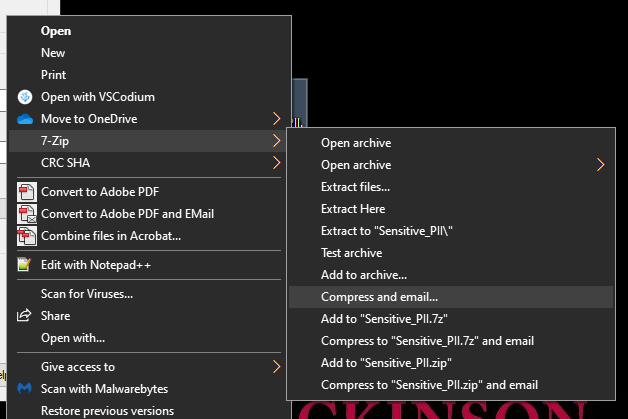
On the drop down menu, Find 7zip
Click “Add to archive…“
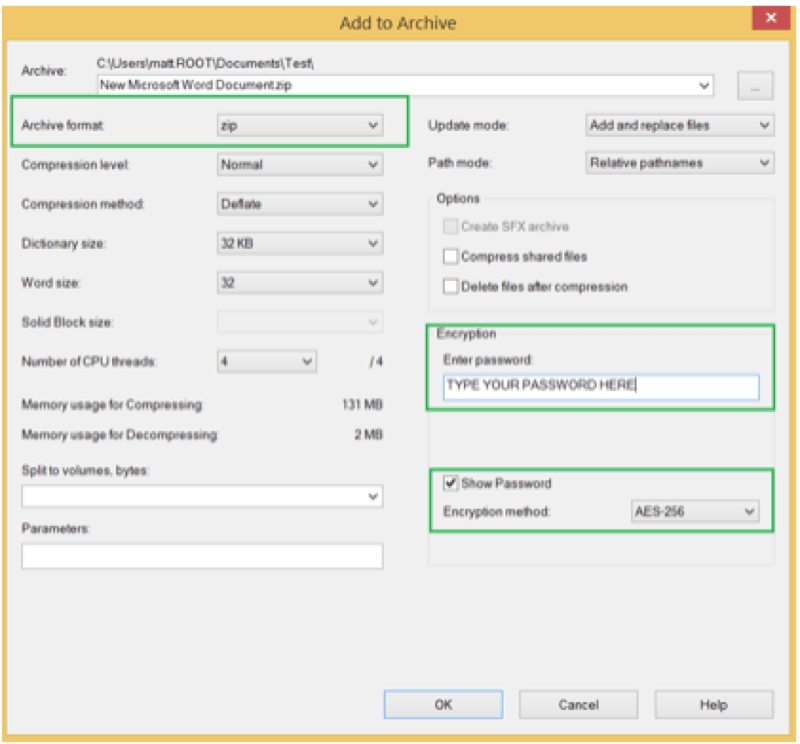
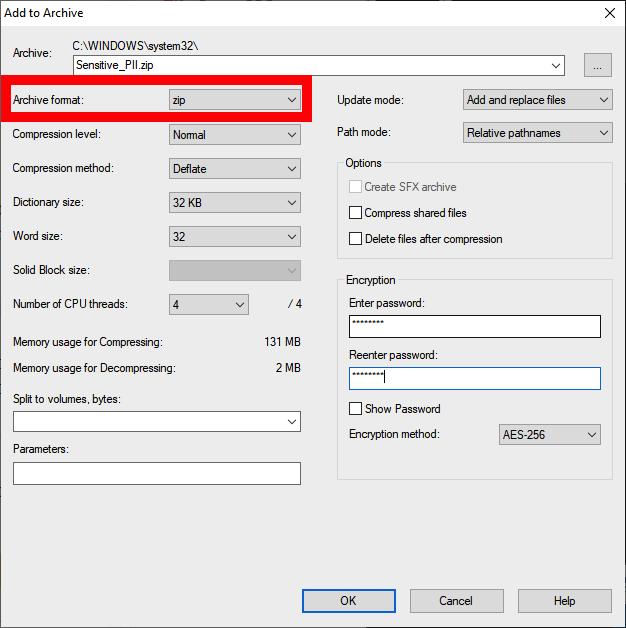
When 7zip opens, there are three (3) settings which need to be changed:
Archive Format = Select zip from drop down
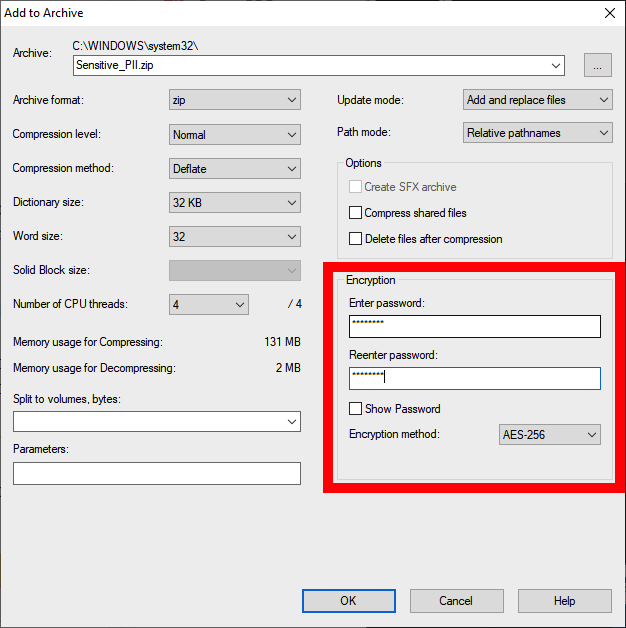
Encryption Method = select AES-256 from drop down
Check “show password” and type in a password that the user creates
Click “OK“
A 7Zip Archive with the encrypted document will now appear in your directory
NOTE: Do not utilize any password that you use to access internal systems. The password cannot be recovered if forgotten.
Editing Encrypted Files and Folders
When editing an encrypted file or folder, you must make sure that you leave the 7zip archive open. If you close the archive, you will be able to work on the document, but it will not save.
Opening an Encrypted File or Folder
To open an encrypted file or folder:
Right click on the 7Zip archive
On the drop down menu, find 7Zip
Click on the first “Open archive”
Click to open your document
Saving an Encrypted File or Folder
To save an encrypted file or folder:
Save the document as normal
Upon closing document, the 7Zip archive will prompt the user to save the changes
Self-Service is an interactive web application that enables students, faculty, and staff to view their individual information contained in FDU’s student information system. Students can use Self-Service to do things like view their financial aid, pay their bills, and register for classes. Likewise, faculty will use Self-Service to verify enrollment and enter grades.
To navigate the Tutorial, scroll down to the Index. From there you can navigate to any portion of the Tutorial by clicking on any “Part”.
What is Degree Audit? Degree Audit is an online version of your check sheet, which allows you to track your academic requirements. On Degree Audit you can see what degree requirements you’ve completed, which are in progress, and which courses you have left to complete your degree.
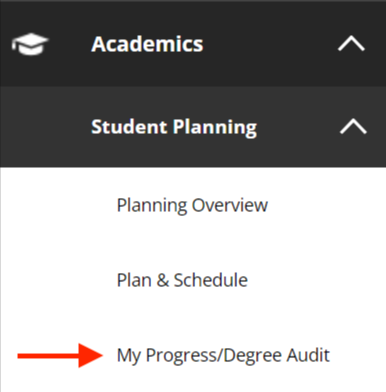
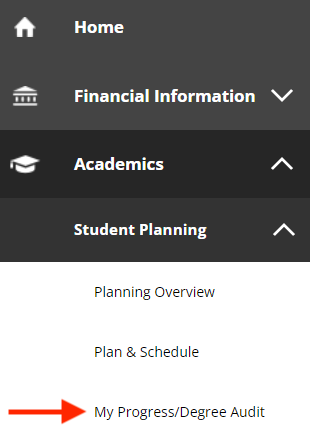
On the left-hand side of the page, you will find your menus. Click on the menu called “Academics” and then click on “Student Planning.” Navigate to “My Progress/Degree Audit”
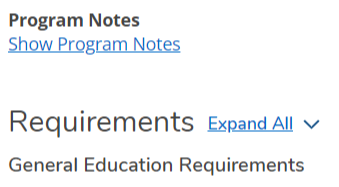
Click on “Expand All” if you’d like to see all the requirements for your degree
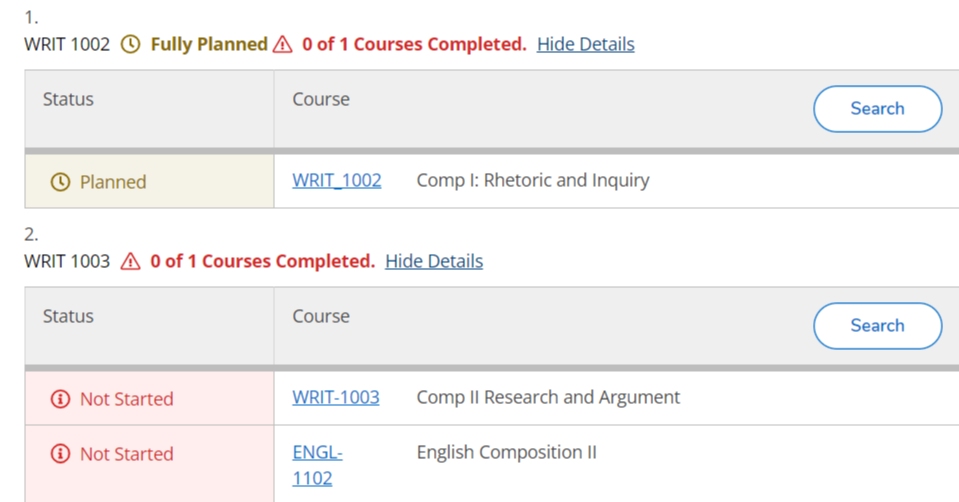
Any action you have taken towards completing each requirement will be noted in the “Status” column
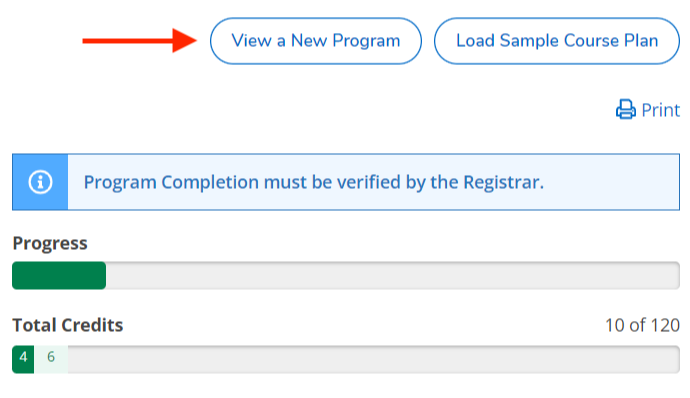
If you would like to see what it would look like if you switched to a different program, then click on “View a New Program” at the top of your Degree Audit
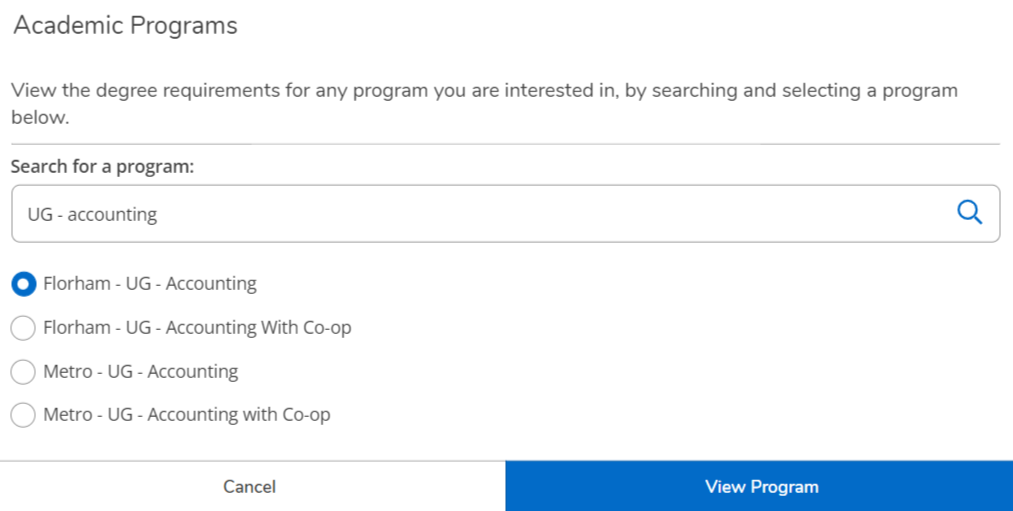
Use the search bar to find the program you are interested in. Select the program and click “View Program
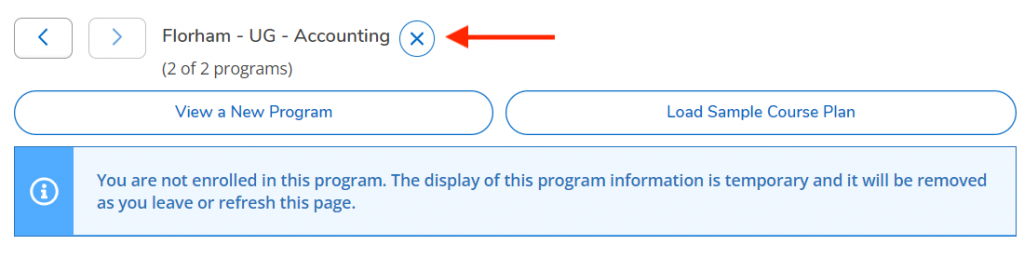
If you no longer want to view this program, click the “X” to remove it
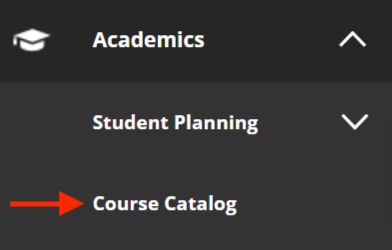
On the left-hand side of the page, you will find your menus. Click on the menu called “Academics” and navigate to the “Course Catalog”
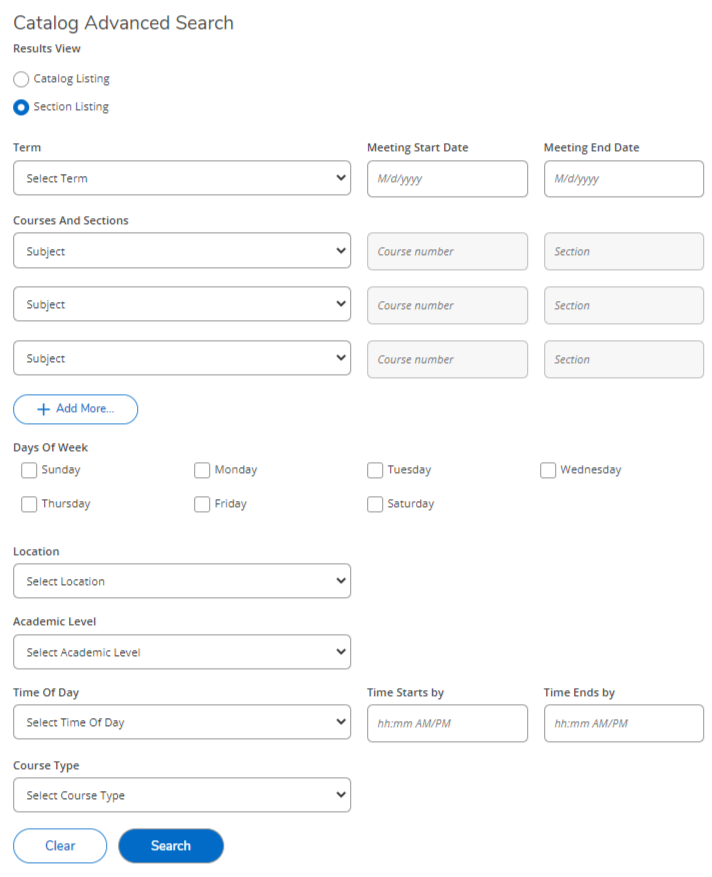
Fill in as many fields as you’d like for your course search. It is suggested that you at least select a term and a subject. Click the blue “Search” button to get your results
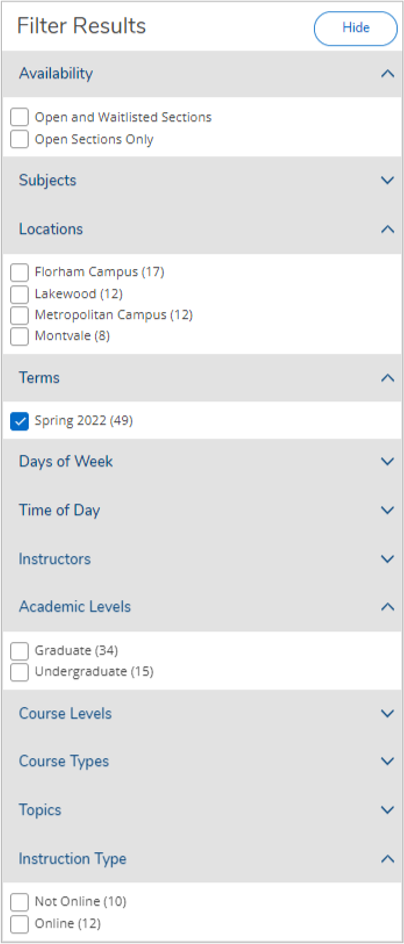
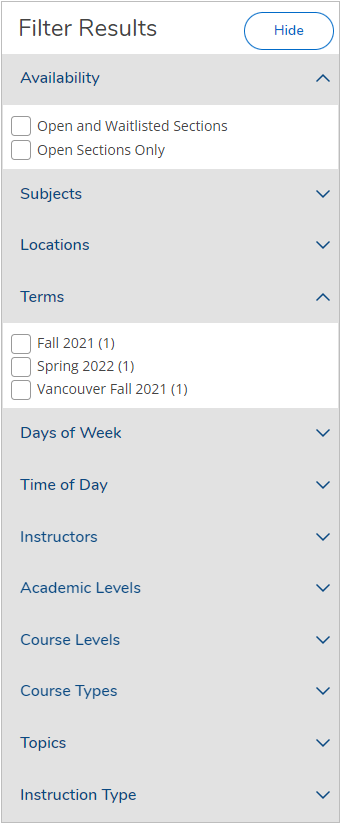
You can narrow down your results further using the filters on the left-hand side
Click on the “Hide” button to hide the filter menu and allow the results to fill your screen
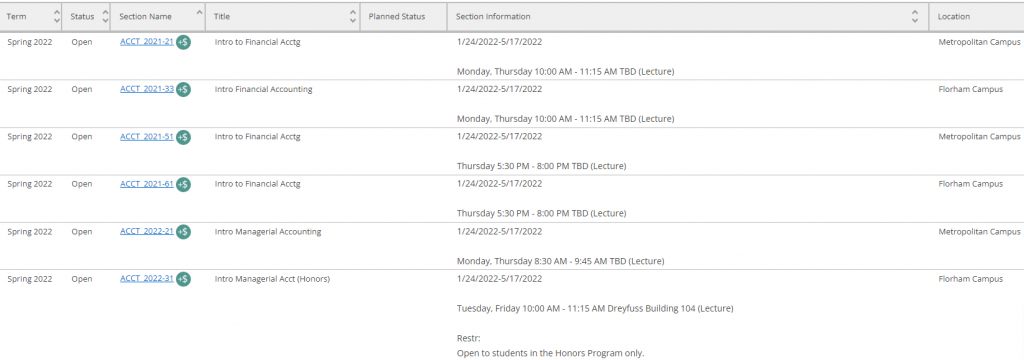
You can click on the arrows in the header row to change how the results are sorted
Note
Section notes and restrictions can be found in the “Section Information” column.
You can search for courses by using the Course Catalog or your Degree Audit page. In this article, we will use the Degree Audit page method
Go to the menu on the left, select “Academics” from the options, and expand the “Student Planning” from the dropdown. Press “My Progress/Degree Audit”
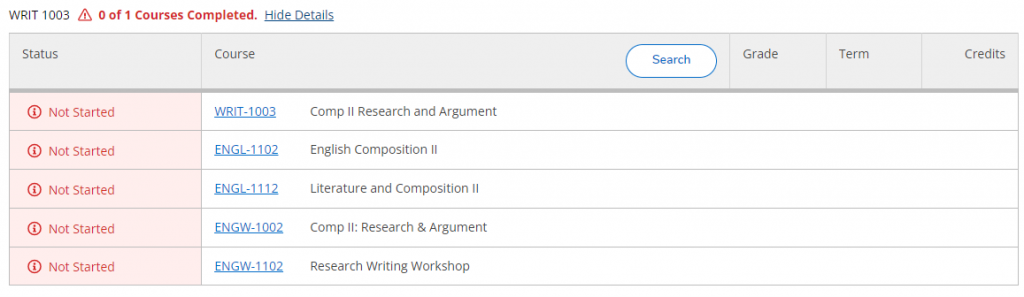
Find the requirements you are looking to fulfill. Press on the “Search” button to find sections for every course that will meet this degree requirement
Note
If you know exactly which course you are interested in, then you can click directly on that course code to view its sections.
Narrow down your results using the filters on the left-hand side.
Tip
Make sure to choose the correct semester.
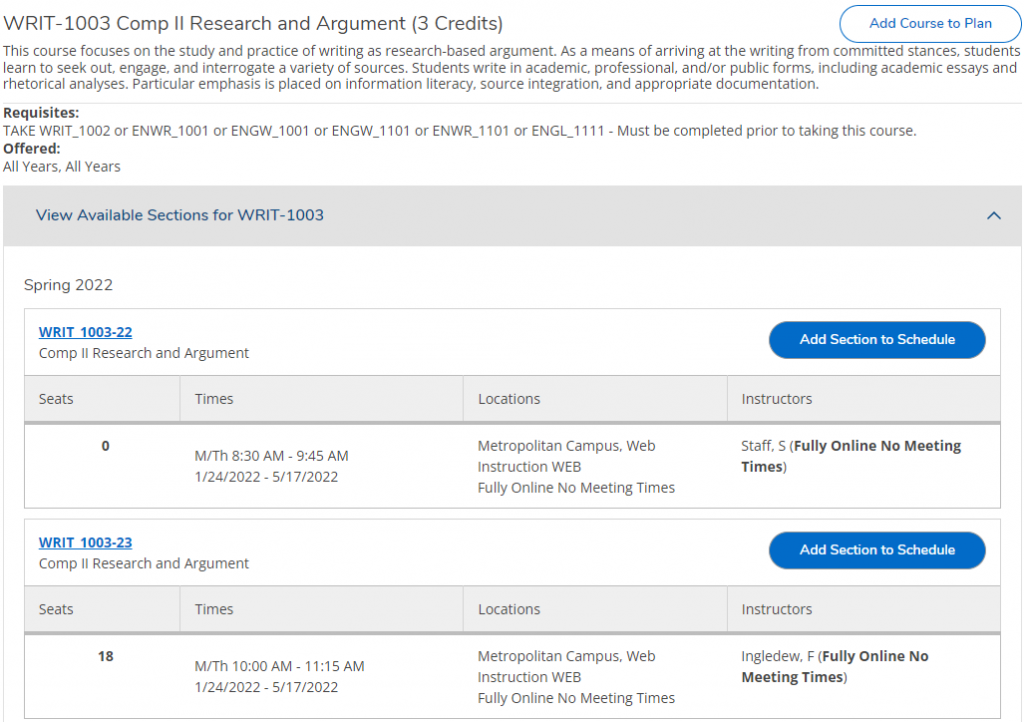
Within the results, click on the grey bar that says “View Available Sections” for the course you’d like to add to your schedule. Find a section that fits on your schedule and click “Add Section to Schedule”
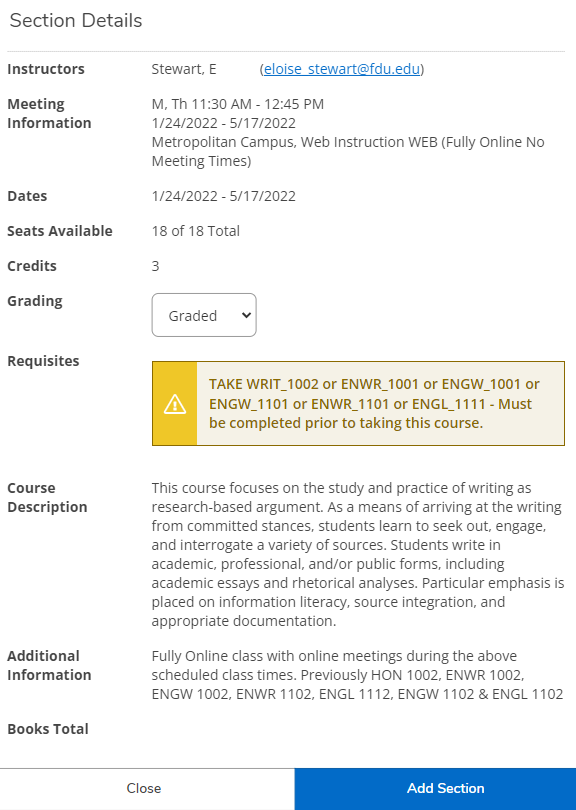
Review the Section Details that pop up. If you still wish to add this section to your schedule, then click “Add Section”
To confirm the section appears on your schedule, navigate to the “Plan & Schedule” page
Tip
Sections can be removed by clicking on the “x” in the top right corner of the section.
Repeat this process to add more courses to your schedule in preparation for priority registration
Important
Planning a section does not guarantee you have a spot in that section.
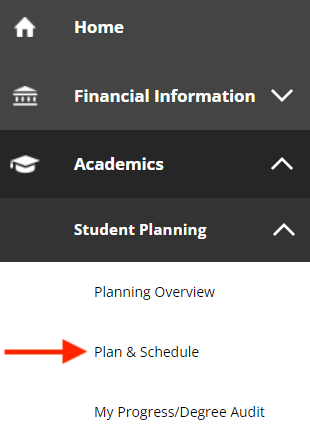
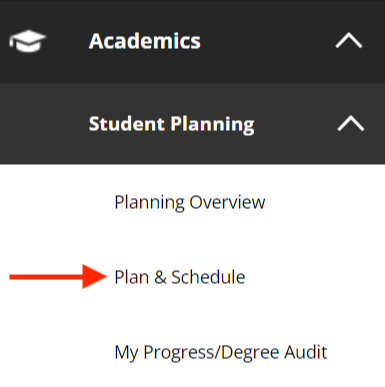
On the left-hand side of the page, you will find your menus. Click on the menu called “Academics” and then click on “Student Planning.” Navigate to “Plan & Schedule
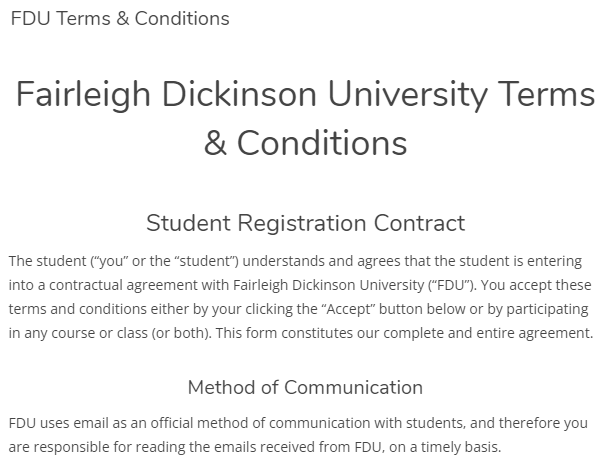
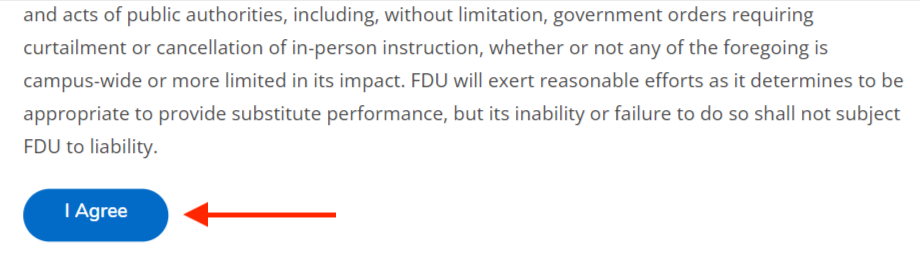
The first time you come to this page for a given semester, you will be presented with the FDU Terms and Conditions Student Registration Contract. Scroll down to agree. You only need to do this once per term
Scroll all the way down to the “I Agree” Button
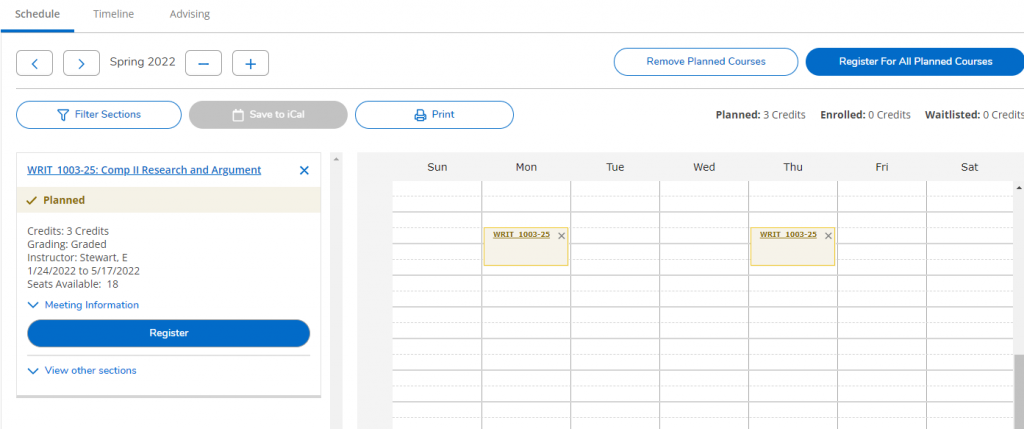
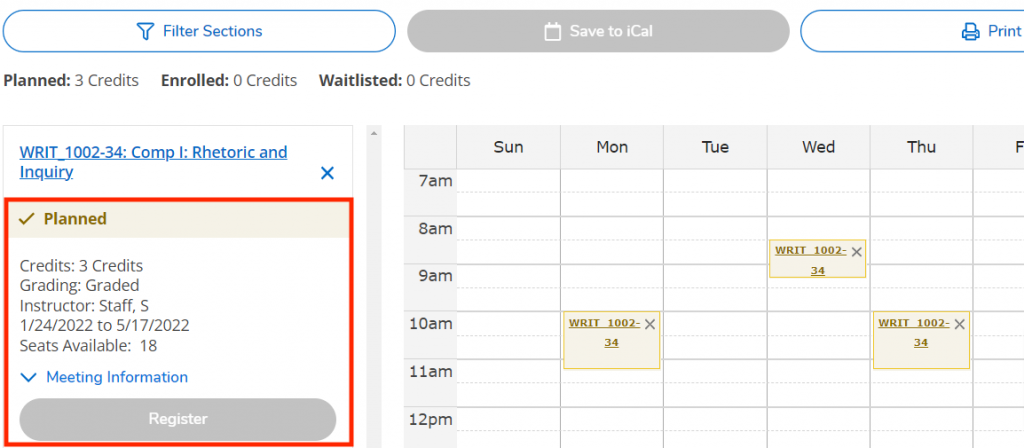
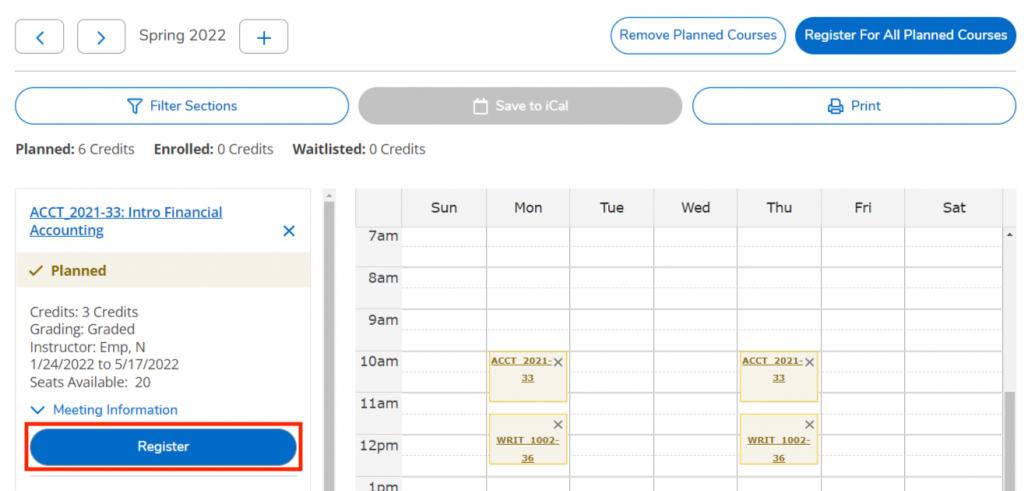
Your planned courses will appear on the Plan & Schedule page and will be color-coded in yellow. If you have not planned your courses, please review how to in Section 1 – Part 3 “How to Plan Your Schedule Using Self-Service”
If you have any holds, then they will appear in the top right corner of the page. You will need to resolve your holds before you can register for classes
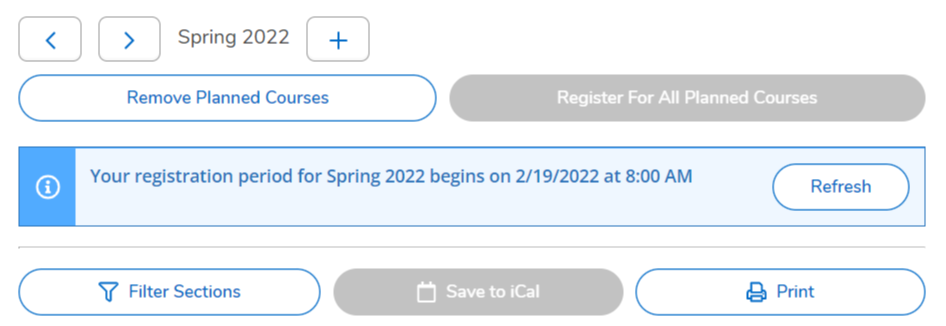
You will need to be mindful of your priority registration date. You will find a banner above your planned schedule informing you of the date and time you can register for classes
Once all holds have been resolved and your priority registration date/time has arrived, you can register for all your courses by clicking on “Register For All Planned Courses.” If you would like to register for each course one at a time, then click on “Register” within each course tile
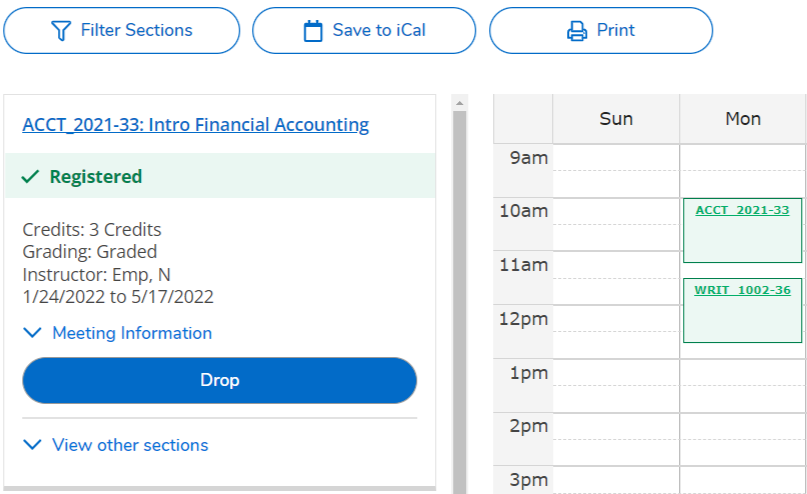
Successful registrations will turn green and say “Registered”
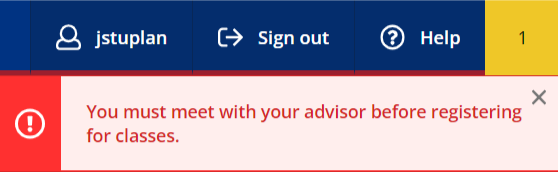
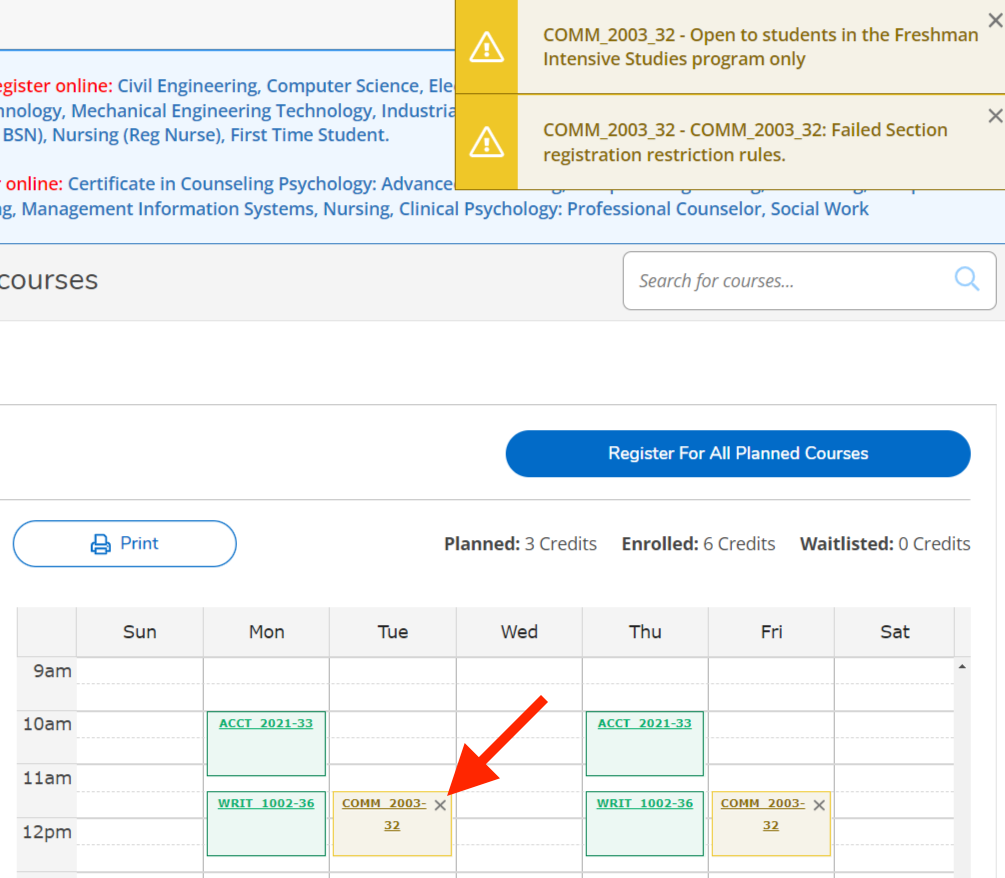
If you are ineligible for any of your planned sections, then the course will remain yellow and planned. You will get an alert in the top right corner explaining why you were unable to register for that section
Click “x” on the section to remove it from your schedule
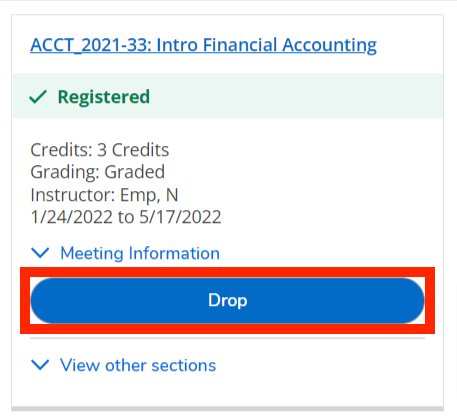
If you need to drop a course during Priority Registration or Add/Drop, then click on “Drop” within the course tile
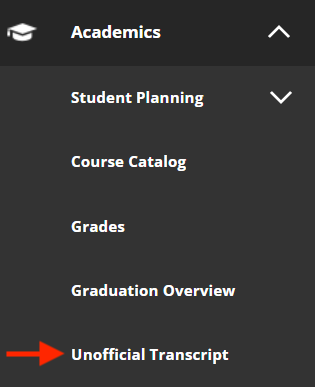
On the left-hand side of the page, you will find your menus. Click on the menu called “Academics” and click on the “Unofficial Transcript” button
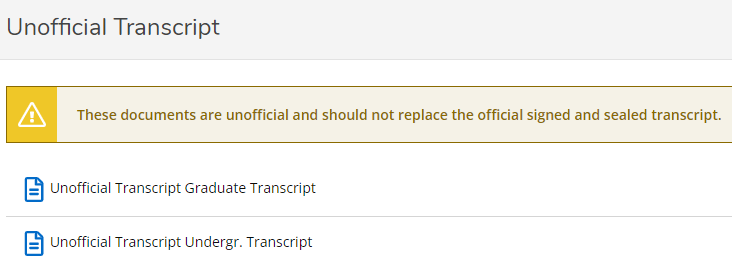
Select the transcript you wish to download by clicking on its text
Important
These documents are unofficial and do not replace official signed and sealed transcripts. To order official transcripts you must go to www.getmytranscript.org.
After clicking on the transcript text, a pdf document will download. Open this document to view your unofficial transcript.
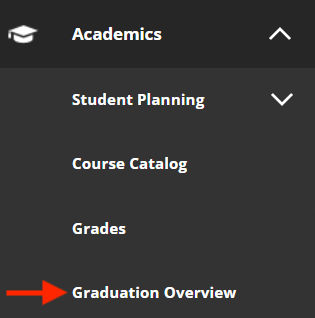
On the left-hand side of the page, you will find your menus. Select “Academics” from the side menu and then select “Graduation Overview”
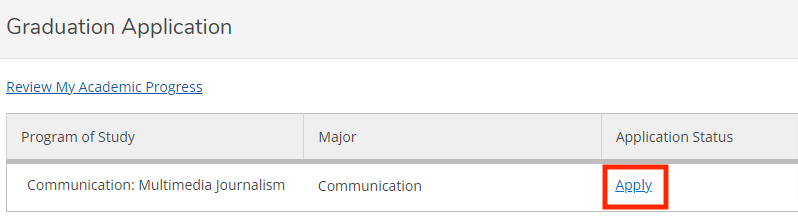
Press “Apply” next to the program from which you wish to graduate
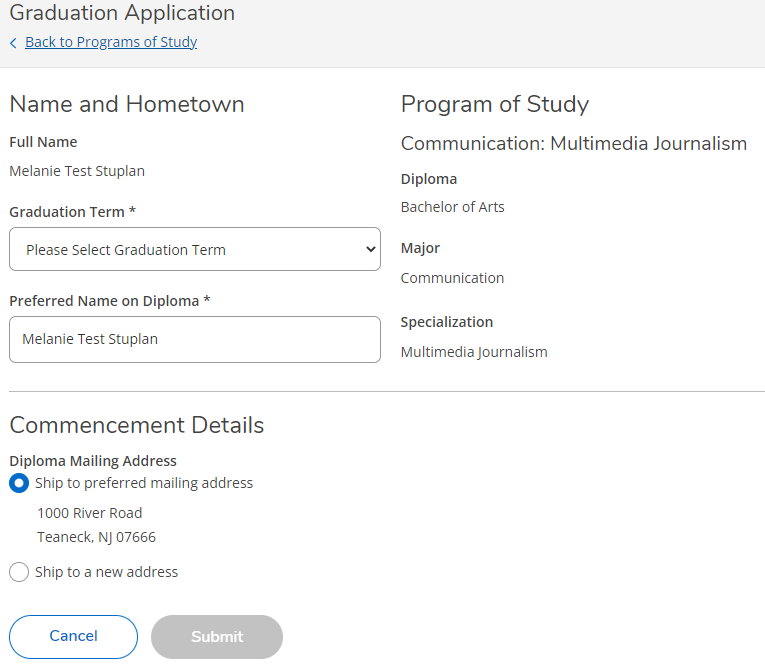
Select your “Graduation Term” and type in your “Preferred Name on Diploma.” Select the address you would like your diploma sent to. Once these fields are filled in, you must confirm everything is correct and press “Submit”
Important
Upon submitting the graduation application, students will be charged the appropriate fee in accordance with the degree they are seeking. Please do not apply more than once.
What is a course plan? A course plan is an example of the sequence of coursework you need to complete for your selected program. This will load courses onto your plan for current and future semesters. This will allow you to map out the courses you must take for your degree.
Note
Not every program has a course plan available.
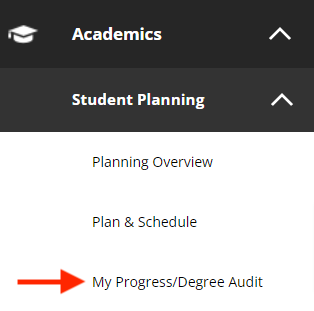
On the left-hand side of the page, navigate to “Academics.” Within the “Student Planning” dropdown menu, press “My Progress/Degree Audit”
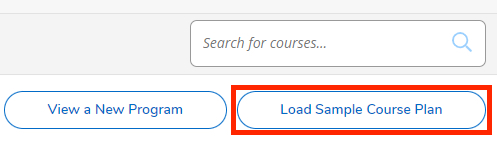
On the top right side of the page, press “Load Sample Course Plan”
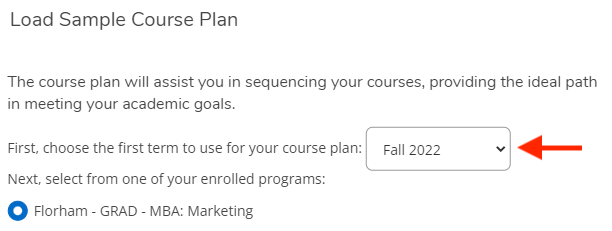
Select your first term from the drop-down menu and select your program using the first radio button
Press on “Preview Plan” at the bottom of the window
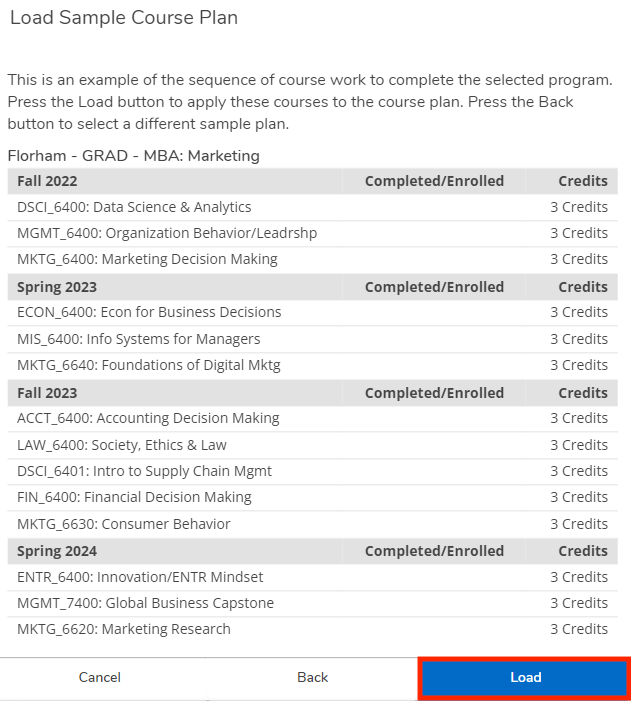
Review the sample course plan and press “Load”
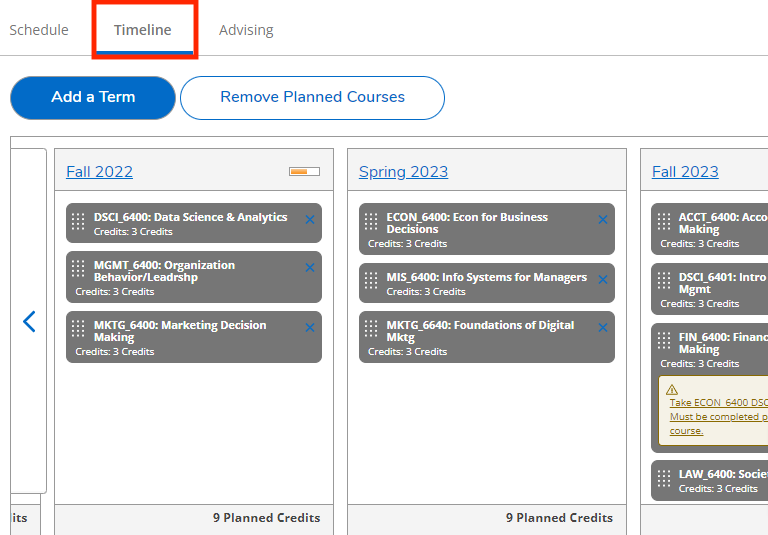
Use the Timeline tab to view the courses that were loaded onto your plan. Make any adjustments, if needed
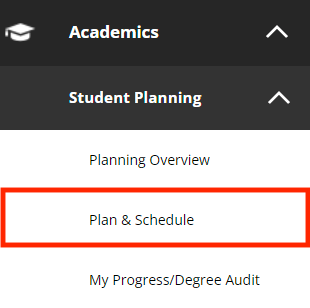
On the left-hand side of the page, you will find your menus. Click on the menu called “Academics.” Within the “Student Planning” menu, click on “Plan & Schedule”
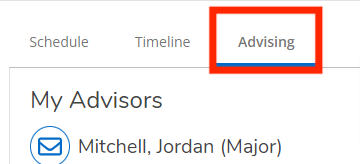
Go to the “Advising” tab. Here you will see the names of your advisors
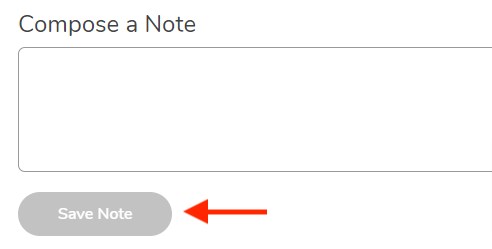
You can leave a message for your advisor by typing in the “Compose a Note” box and clicking “Save Note“
Click “Request Review” to have your advisor notified that your schedule is ready to be reviewed and approved
If a class you have planned is full and has a waitlist enabled, then follow these steps to join the waitlist. Please note that there is no guarantee that you will get a spot in the course section.
Note
Students have the option to place themselves on the waitlist to see if a seat becomes available in the course section. For a course that offers waitlisting as an option, plus-ins are no longer a standard practice; neither an advisor nor a professor can approve a plus-in for a class. All registration rules and restrictions apply to waitlisting, so you may not be able to place yourself on a waitlist if you are not eligible. If you encounter difficulties adding yourself to a waitlist due to restrictions, you should reach out to your Academic Advisor for assistance.
Go to the “Academics” menu, click on “Student Planning,” and navigate to “Plan & Schedule“
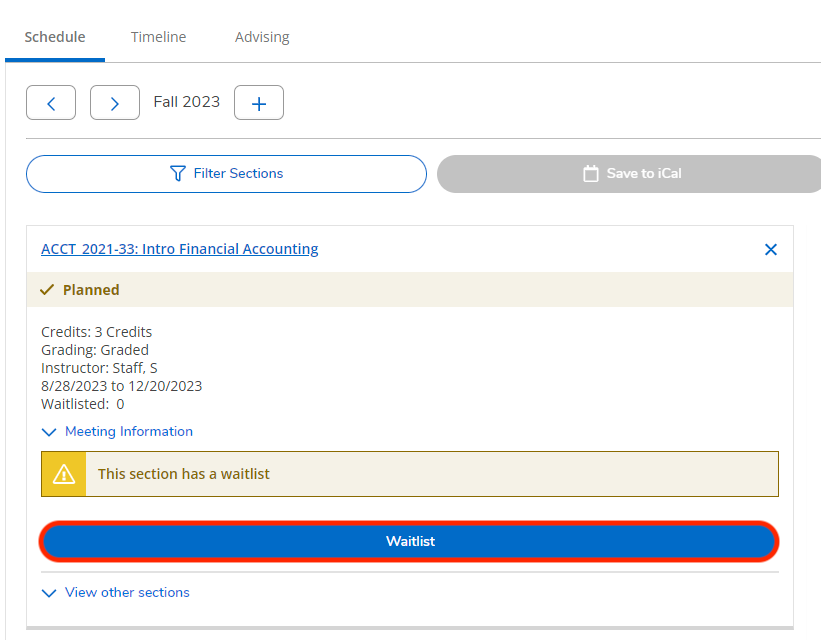
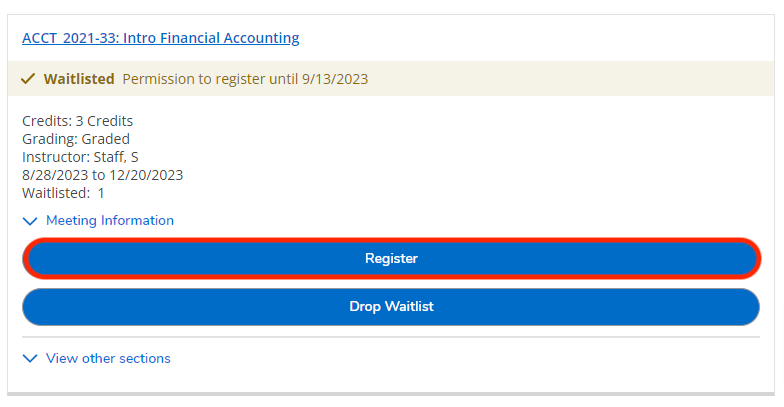
Find the section that is full. If the waitlist is active, you will see a “Waitlist” button
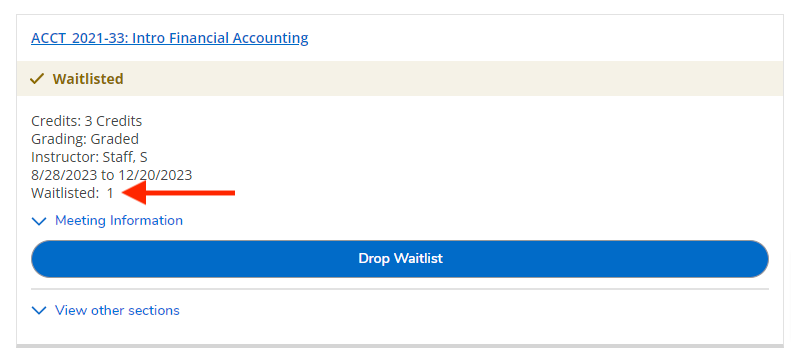
Once you’ve joined the waitlist, the number of waitlisted students will increase by one and you will have the option to drop off the waitlist
When a spot opens in the section, you will get a notification sent to your FDU email address
Note
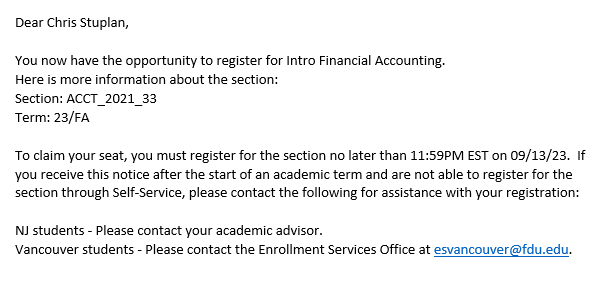
You will only have until 11:59 PM EST on the day specified in the email to register for the section. If you do not register on time, the spot will be offered to the next person on the waitlist.
There will now be a “Register” button on the section within the Plan & Schedule page. Click on it to register for the waitlisted course
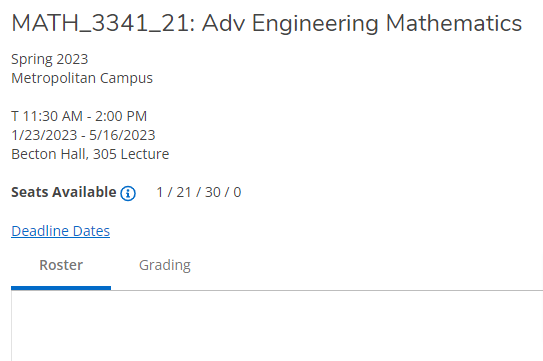
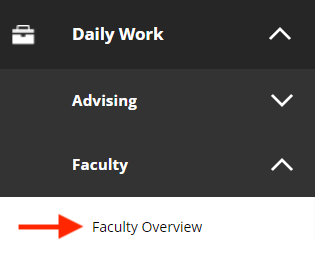
On the left-hand side of the page, you will find your menus. Click on the toolbox icon, called “Daily Work”, and navigate to the “Faculty” submenu. Within this submenu, click on “Faculty Overview”
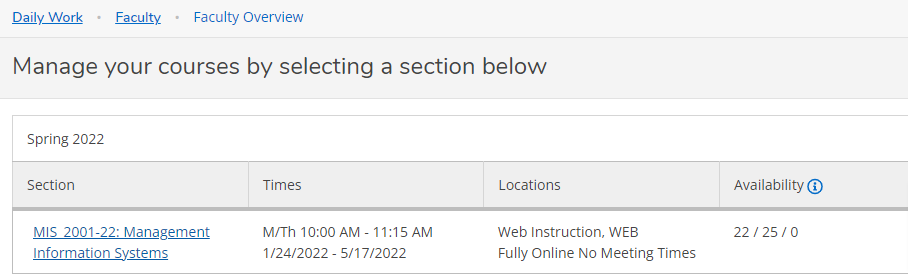
Click on the row of the course you wish to verify the enrollment
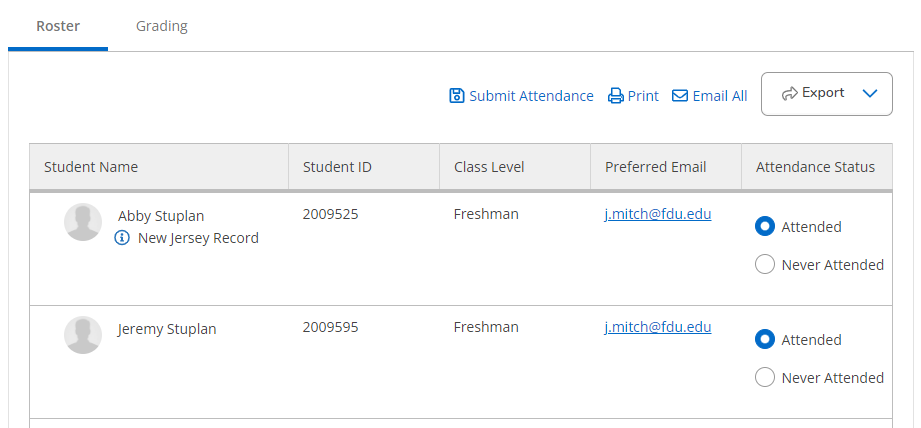
Within the “Roster” tab, you will see the list of students currently enrolled in the course. Use the radio buttons to select whether the student has “Attended” or “Never Attended”
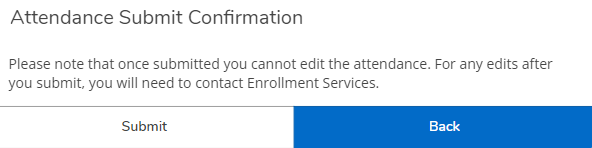
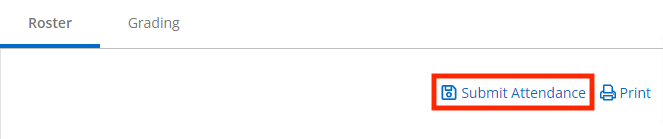
Once you have completed verifying enrollment, you must click on “Submit Attendance“
Click on “Submit” in the pop-up window to complete the process
Important
Once you’ve submitted attendance, you cannot make any changes in Self-Service. If you need to make a change, you must contact Enrollment Services: Metro Campus – esteafdu@fdu.edu AND/OR Florham Campus esmadfdu@fdu.edu.
After you’ve submitted the enrollment verification, you will see a green notification at the top of the page letting you know you were successful
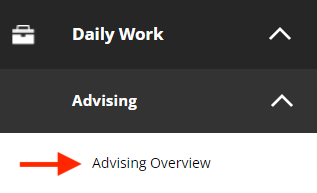
On the left-hand side of the page, you will find your menus. Click on the toolbox icon, called “Daily Work”, and navigate to the “Advising” submenu. Within this submenu, click on “Advising Overview“
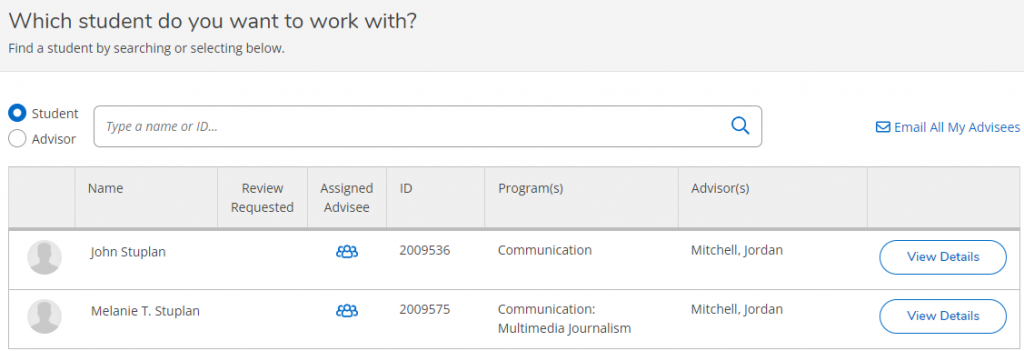
Find the student you wish to advise using the prepopulated table of assigned advisees or by searching for their name or ID number in the search bar.
Note
You can search for any student, whether you are their advisor or not, by using the search bar.
Click on the “View Details” button for the record of interest
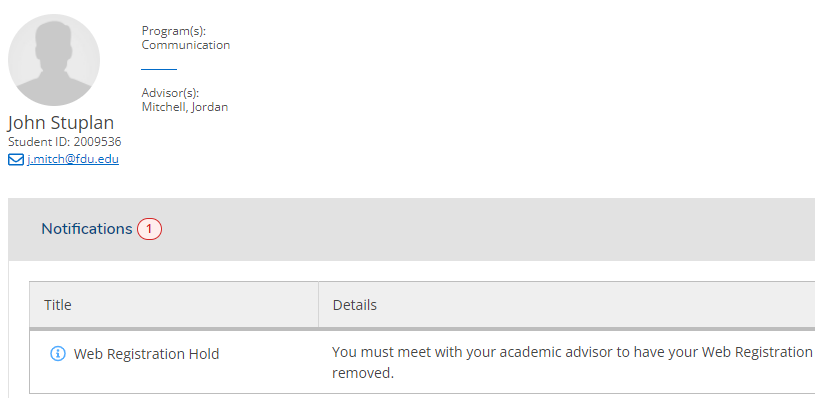
Click on the “Notifications” bar to expand it and view any holds on the student’s account
Underneath the “Notifications” bar, you will find all the tabs you can use to gain a well-rounded view of the student’s academic progress
Click on “Course Plan” to view the courses the student has registered for or is planning to register for
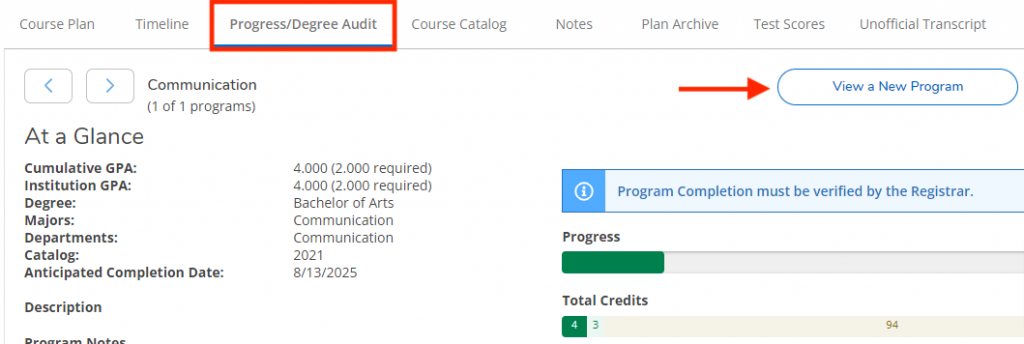
Click on “Progress/Degree Audit” to view the student’s Degree Audit. Within this tab, you can click on “View a New Program” to see what it would look like if this student switched programs
Click on “Test Scores” to see any official test scores that have been submitted to FDU and recorded in Colleague
Click on “Grades” to view the student’s midterm and final grades broken down by semester
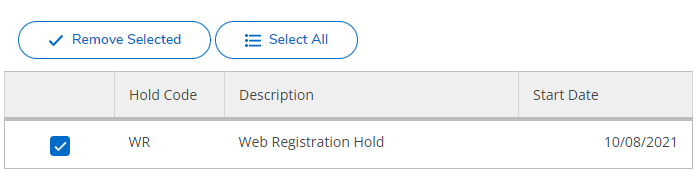
Click on “Remove Hold” to remove the web registration hold from the student’s account. You will need to select the hold you wish to remove and click on “Remove Selected”
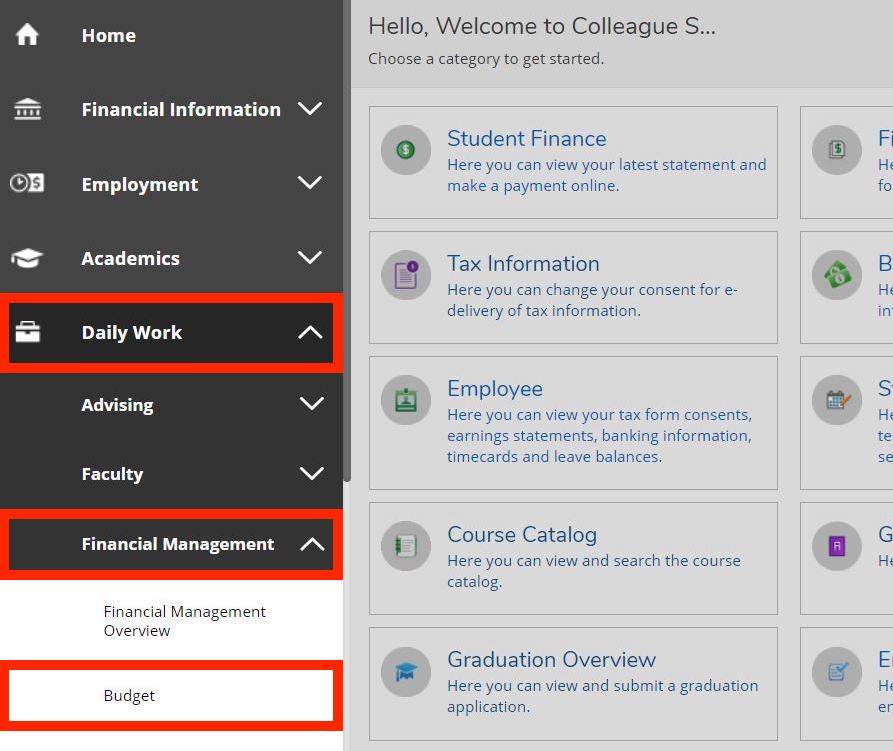
On the left-hand side of the page, you will find your menus. Click on the toolbox icon, called “Daily Work”, and navigate to the “Financial Management” sub-menu. Within this sub-menu, click on “Budget”
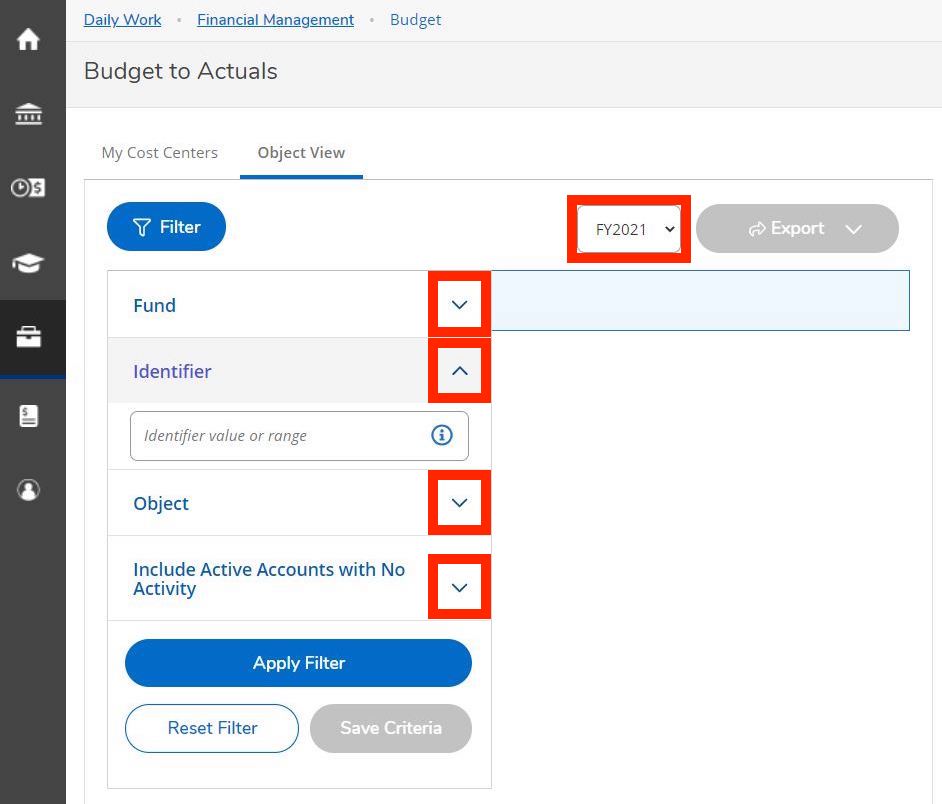
On the “Budget to Actuals” page, there will be options to filter your reports. By clicking on any of the arrows, you can expand or collapse the filter options. Once expanded, a field will appear where you can type the criteria you would like to search for. Additionally, you can change the Fiscal Year using the drop-down menu at the top of the page
Using “Identifier” as an example, you can type in your value(s) in the following ways. Hit “Enter” after each value to include in the search
Type in the individual identifier, ex: 067110
Type in the range of identifiers, ex: 067110-067115
Type in the identifiers separated by commas, ex: 067110, 067111, 067115
Click “Apply Filter” when done entering values. Your results will appear to the right of your filter menu
If you need to change your filters:
Open up the filter options by clicking on the blue “Filter” button
You can add more values by typing them into the field, hitting “Enter”, and applying the filter again
You can remove individual values by clicking on the “X” next to the value
You can start over completely by clicking “Reset Filter”
If you are satisfied with your filter options and would like to detail in on a specific budget, then click anywhere on the budget you would like to view
Click anywhere within a row to view more details. The “Financial Health” column will display a yellow alert symbol if the budget is over 85% spent
Continue to click on rows or documents to view more details. Download any page with an “Export” icon if you need to view it in Excel. You can click Back in your browser to go back a page
On the left-hand side of the page, you will find your menus. Click on the toolbox icon, called “Daily Work”, and navigate to the “Financial Management” sub-menu. Within this sub-menu, click on “Budget”
On the “Budget to Actuals” page, there will be options to filter your reports. By clicking on any of the arrows, you can expand or collapse the filter options. Once expanded, a field will appear where you can type the criteria you would like to search for. Additionally, you can change the Fiscal Year using the drop-down menu at the top of the page
Using “Identifier” as an example, you can type in your value(s) in the following ways. Hit “Enter” after each value to include in the search
Type in the individual identifier, ex: 067110
Type in the range of identifiers, ex: 067110-067115
Type in the identifiers separated by commas, ex: 067110, 067111, 067115
Click “Apply Filter” when done entering values. Your results will appear to the right of your filter menu
If you need to change your filters:
Open up the filter options by clicking on the blue “Filter” button
You can add more values by typing them into the field, hitting “Enter”, and applying the filter again
You can remove individual values by clicking on the “X” next to the value
You can start over completely by clicking “Reset Filter”
If you are satisfied with your filter options and would like to detail in on a specific budget, then click anywhere on the budget you would like to view
Click anywhere within a row to view more details. The “Financial Health” column will display a yellow alert symbol if the budget is over 85% spent
Continue to click on rows or documents to view more details. Download any page with an “Export” icon if you need to view it in Excel. You can click Back in your browser to go back a page
Note
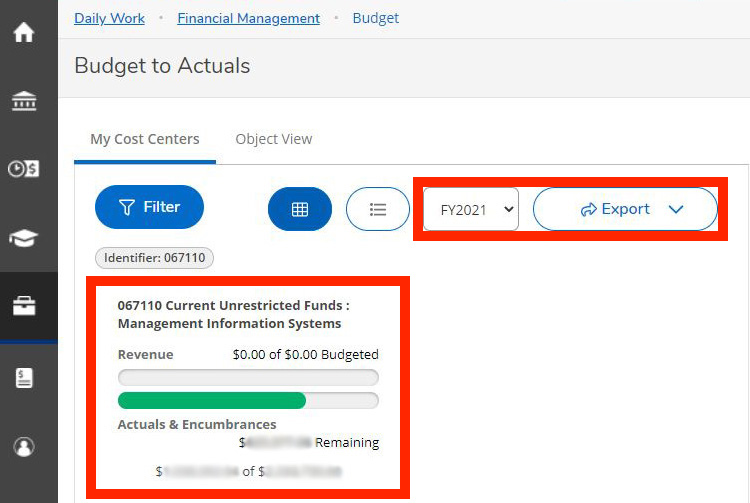
Anytime you see the FY drop-down menu at the top of the page, you can change the FY you are viewing. Likewise, whenever you see the Export drop-down menu, you can download the information in your current view into a CSV file and open in Excel.
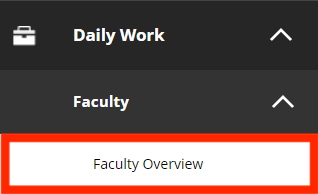
Go to the “Daily Work” menu, click on “Faculty,” and then click on “Faculty Overview“
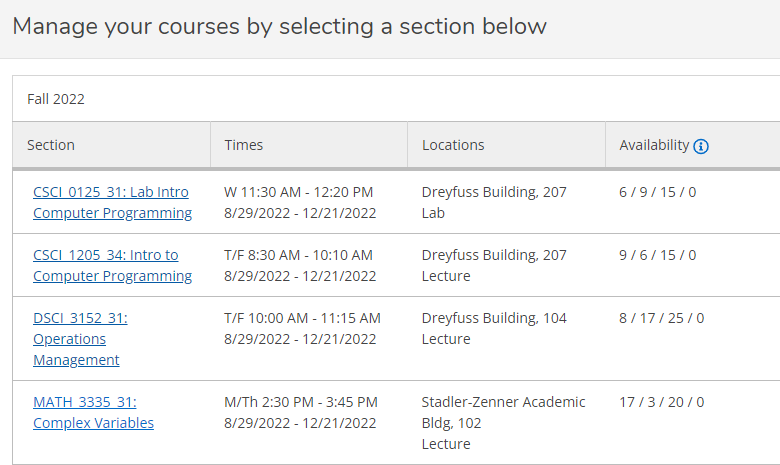
Select the course for which you need to enter midterm grades
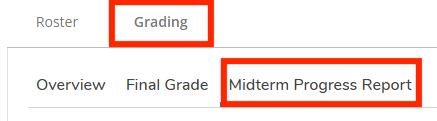
Within the “Grading” tab, select the “Midterm Progress Report” tab
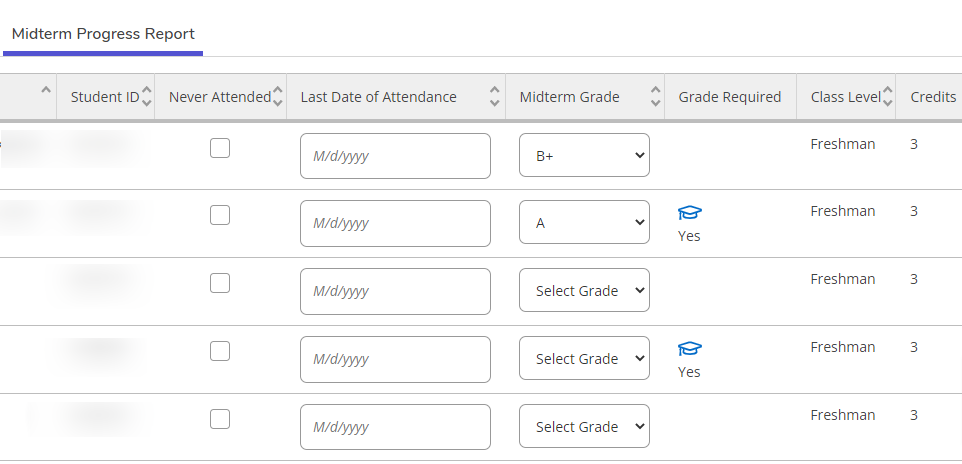
Use the drop-down menu to select the grade for each student
Note
The “Grade Required” column will indicate which students MUST be given a midterm grade.
Note
There is no Submit button for Midterm grading. Grades are automatically saved when selected from the drop-down. Midterm grades may be changed at anytime, if needed.
Go to the “Daily Work” menu, click on “Faculty,” and then click on “Faculty Overview“
Select the course for which you need to enter final grades
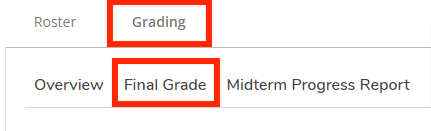
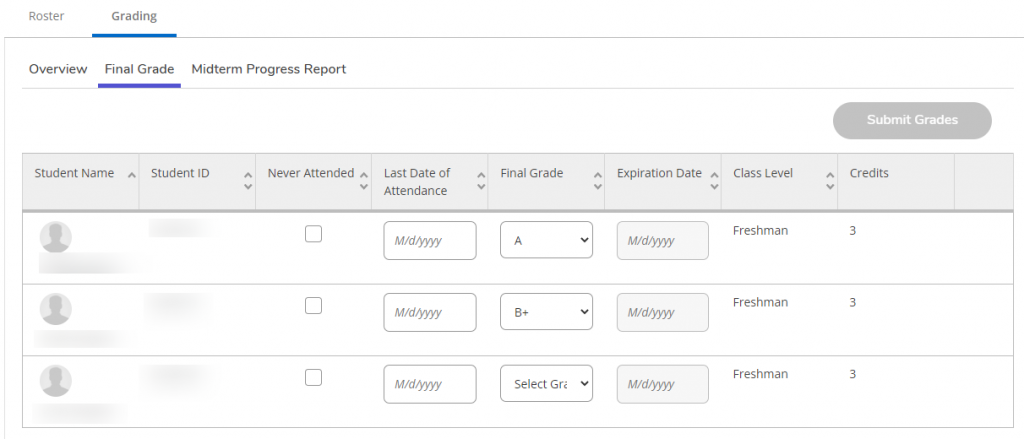
Within the “Grading” tab, select the “Final Grade” tab
Use the drop-down menu to select the grade for each student
Note
A grade must be entered for every student in order to submit grades.
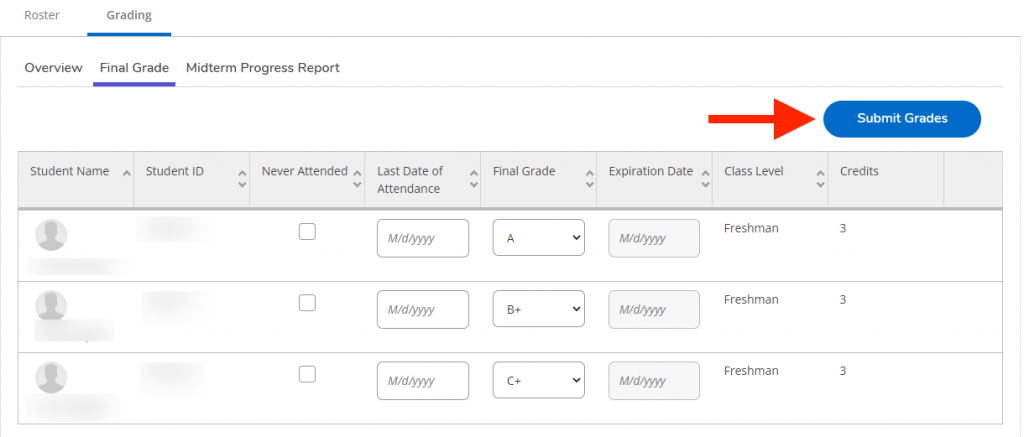
Once all grades have been entered, you must click the “Submit Grades” button to save and submit your work
Note
You have a short window where you can change grades and resubmit in Self-Service. However, once grades have been verified in Colleague, you will no longer be able to make a change in Self-Service. You will then need to go through the Change of Grade process.
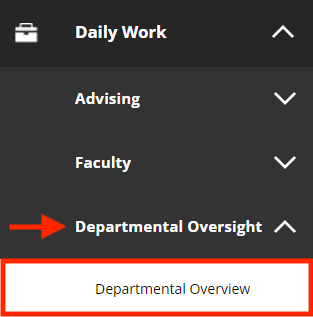
Go to the Daily Work menu and click on “Departmental Oversight“. Within this menu, click on “Departmental Overview“
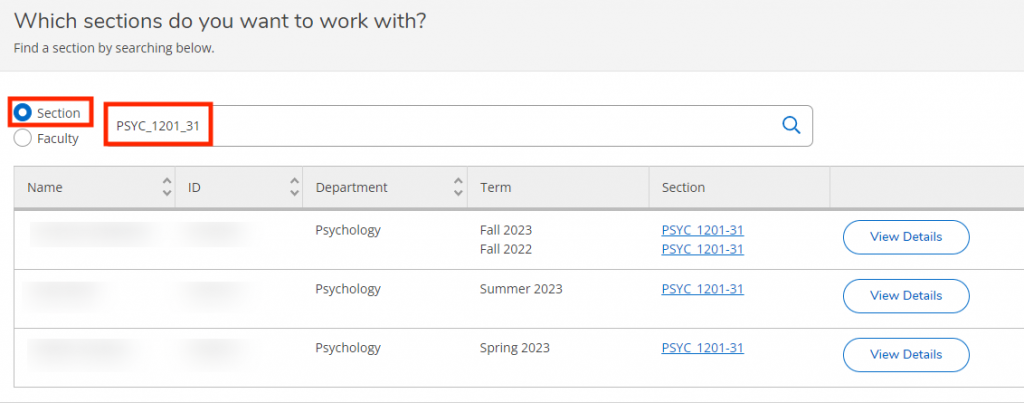
To search for a section by course code, click on the “Section“radio button. Type in the section information using the following valid formats only:
Subject Code Only – Ex: PSYC
Catalog Number – Ex: PSYC_1201
Specific Section – Ex: PSYCH_1201_31
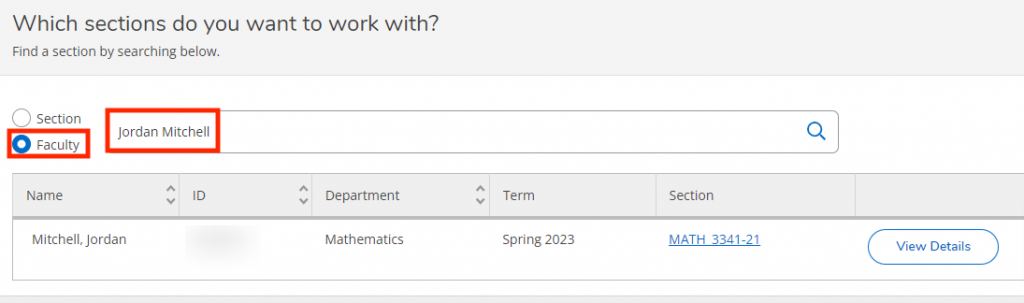
To search for all the sections being taught by a specific faculty member, click on the “Faculty” radio button. Type in the faculty member’s name using the following valid formats only:
First Name Last Name – Ex: Bob Smith
Last Name, First Name – Ex: Smith, Bob
Once you’ve found the section or faculty member you searched for, click on “View Details“
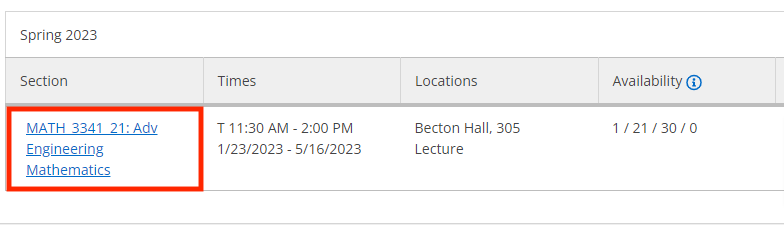
To view the Enrollment Verification or Midterm/Final grades associated with a specific section, click on the section name
Enrollment Verification can be found in the Roster tab and Midterm/Final grades can be found in the Grading tab
Note
You will not be able to submit grades on behalf of a faculty member. You can only view the grades that have been submitted.
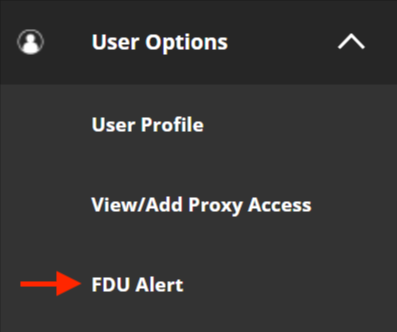
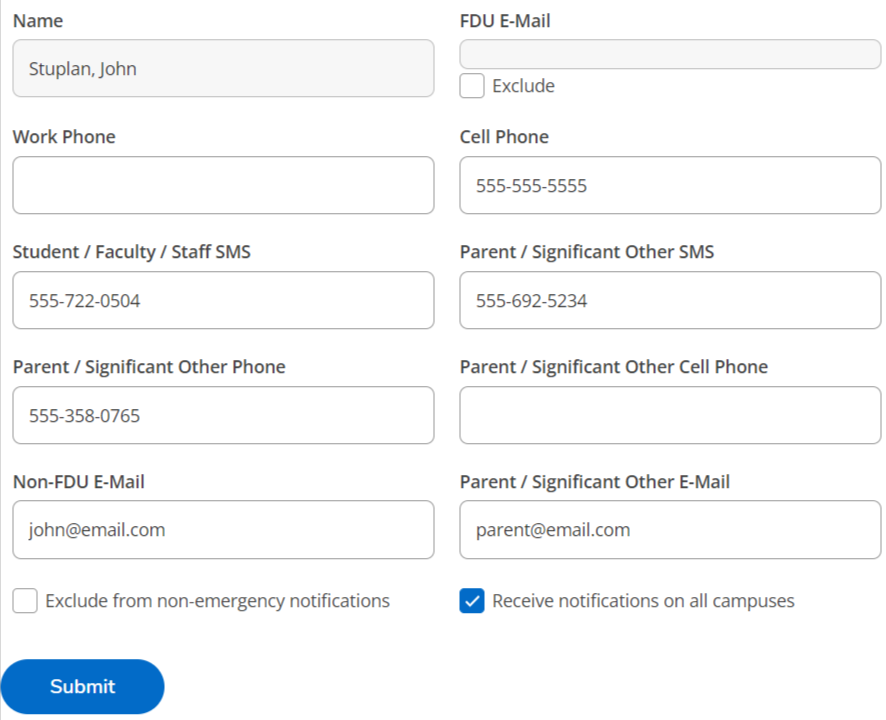
On the left-hand side of the page, you will find your menus. Click on the menu called “User Options” and then click on “FDU Alert”
Fill in the alert information presented on the page. If information already exists in these fields, make sure the information is up to date. Click “Submit” when finished
What is a Proxy? A Proxy isa person to whom you grant permission to sign into your Self-Service account to access selected student records.
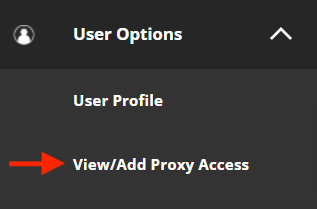
On the left-hand side of the page, you will find your menus. Press on the menu called “User Options” and then press on “View/Add Proxy Access”
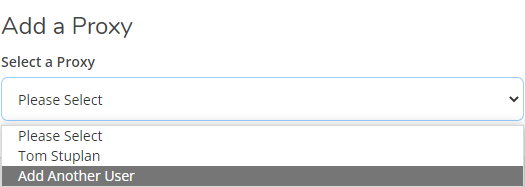
Use the drop-down to add a proxy. If you see the person’s name, select them from the list and confirm their information. If you do not see their name, click on “Add Another User”
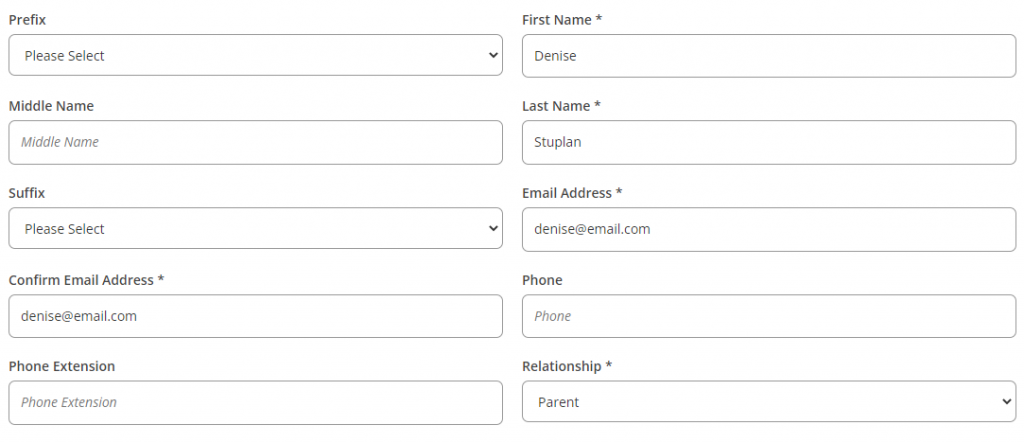
You must fill in the personal information for the proxy
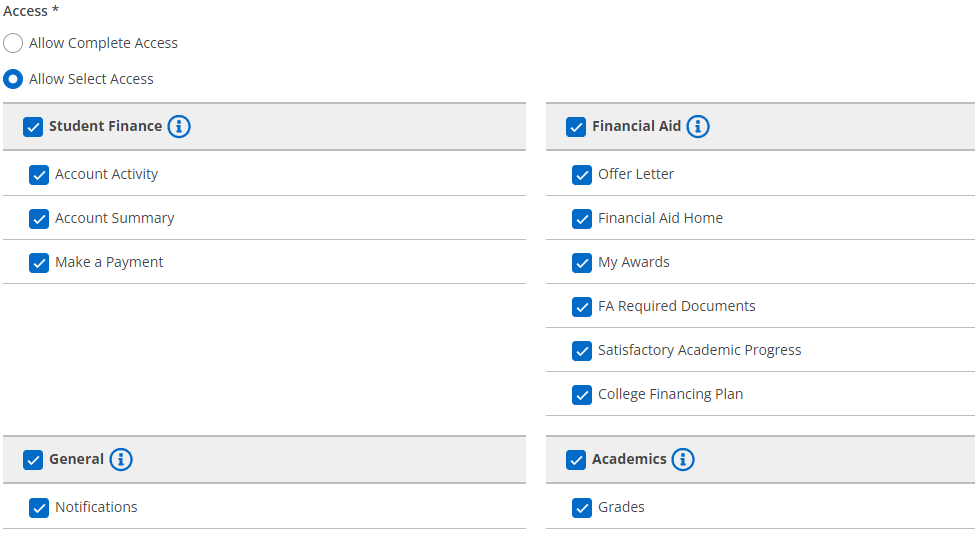
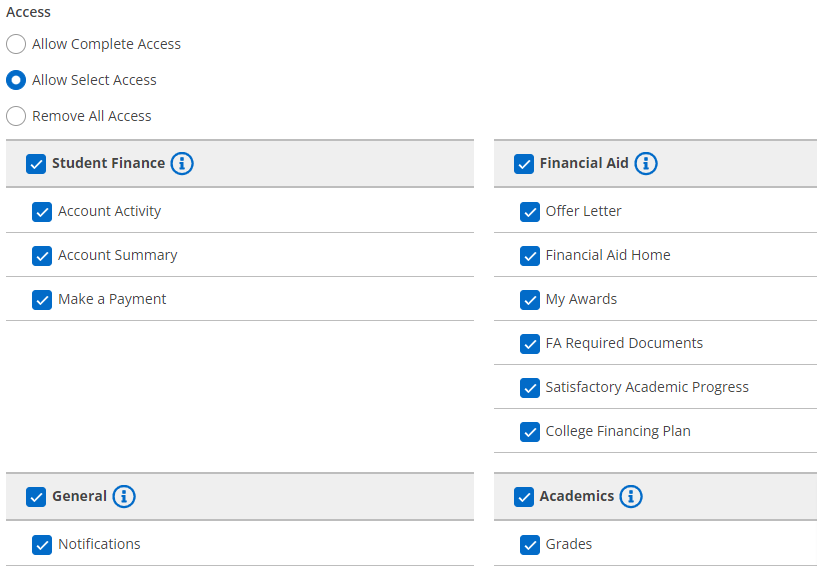
You can pick and choose what access you want to give to this proxy
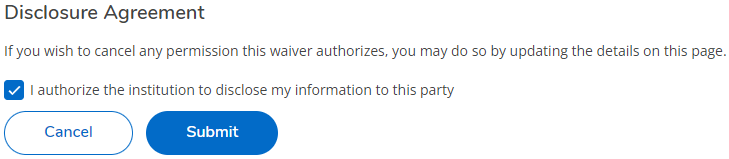
You must agree to the Disclosure Agreement and press “Submit”
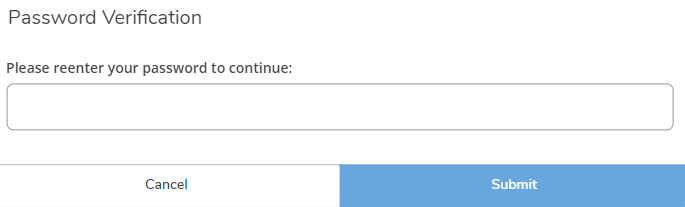
You will be prompted to enter your Single-Sign-On password again and press “Submit”
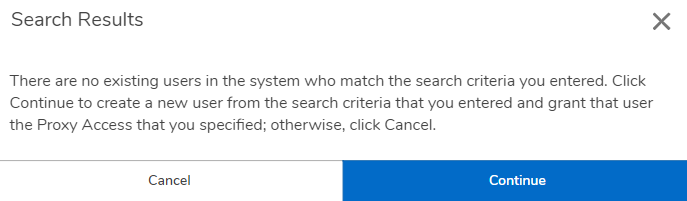
If you add a new user, you might get the following pop-up message. If you do, press “Continue“
Now your proxy will be listed on the “View/Add Proxy Access” page
Note
Proxies will receive an email any time access is granted or revoked.
If you want to change a proxy’s access at any time, simply click on the pencil next to their row
Add or remove access by selecting the appropriate checkboxes. You can also remove all access entirely by selecting the “Remove All Access” radio button. Click “Save” to submit your changes
Important
If you are giving a proxy access to “Make a Payment” you must also make them an authorized user in TouchNet.
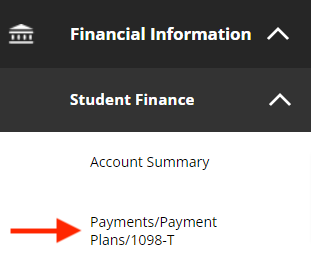
To give access to Make a Payment via an authorized user, click on “Payments/Payment Plans/1098-T” within the “Student Finance” menu
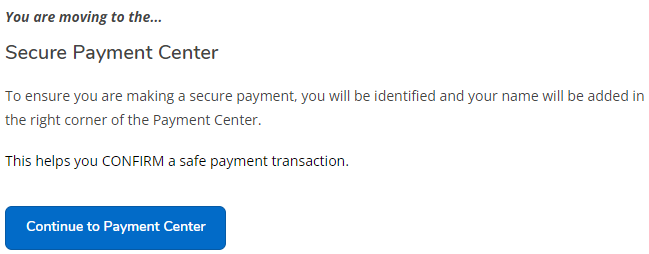
Click on “Continue to the Payment Center” to navigate to TouchNet
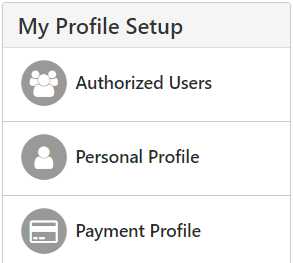
Click on “Authorized Users” to add your proxy as an authorized user to pay your bill. Follow the instructions to add the authorized user
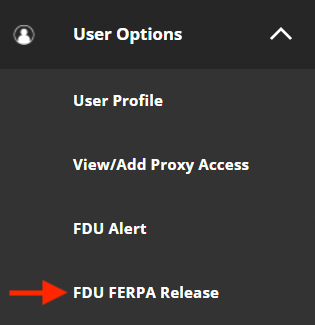
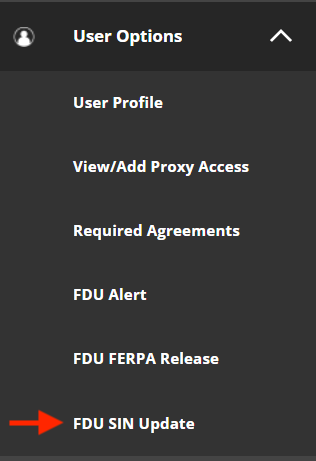
On the left-hand side of the page, you will find your menus. Click on the menu called “User Options” and then click on “FDU FERPA Release”
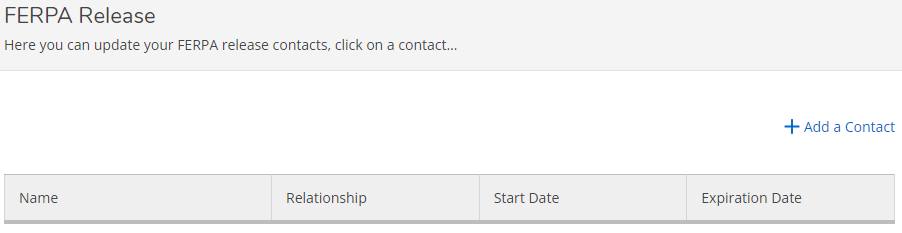
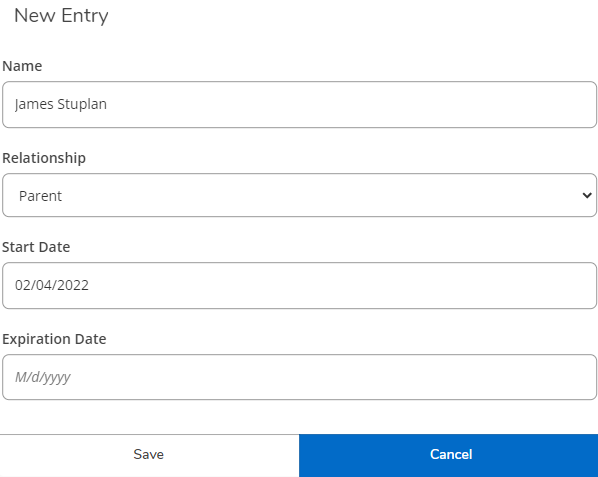
Click on “Add a Contact” to add a new contact, a person to whom you want to grant access to your information
Important
By completing the information on this page, you are authorizing administrators, staff, and faculty members of Fairleigh Dickinson University to release information pertaining to academic records, financial aid, student bill/account and disciplinary records to the contacts you have noted. This waiver remains in effect throughout your tenure as a student at the University. If you wish to cancel the permissions this waiver authorizes, you may do so by updating the details on this page. Please be advised that this waiver DOES NOT apply to services provided by Health and Counseling services. All records pertaining to medical care and psychological services remain confidential.
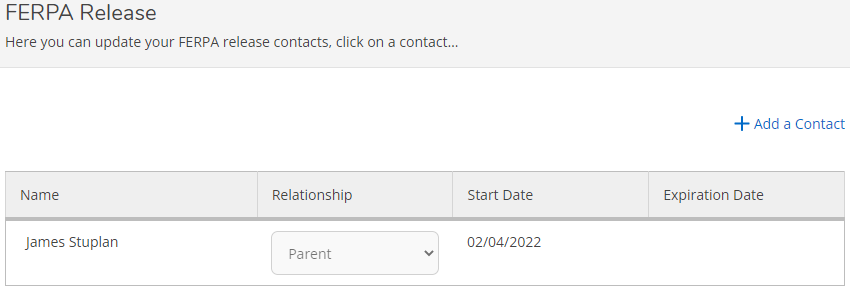
Adding a contact: Fill in the contact’s name, relationship, and the start date (the date that this will become effective). The expiration date is optional and can be changed at any point. Click “Save”
You will now see this contact listed on the FDU FERPA Release page
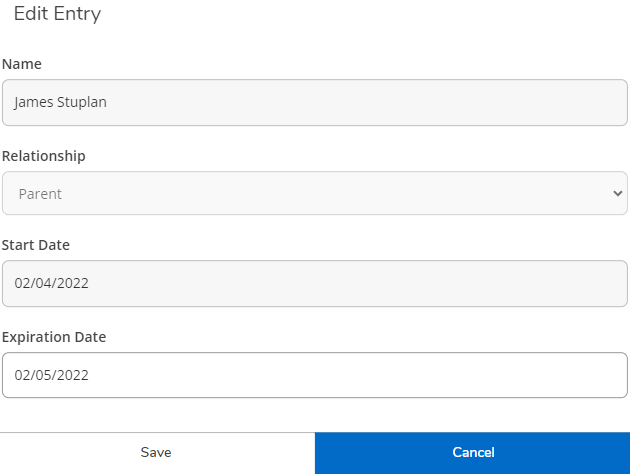
If you want to end the permissions of a contact, press on the row containing their name
Fill in an expiration date to end their permissions on that date. Press “Save”
Repeat the steps above to add or change your contacts
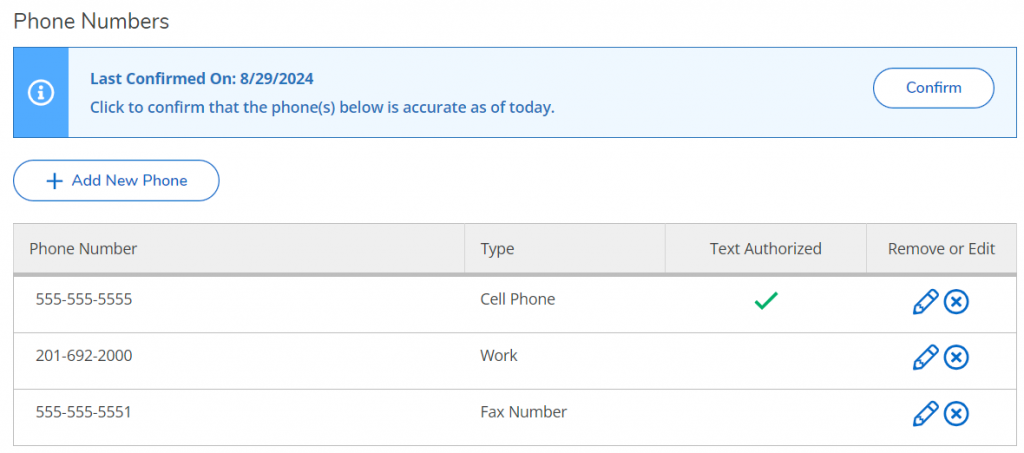
The phone numbers the University has on file to communicate with you are displayed in your User Profile in Self-Service. If the information is incorrect in any way, you can update your contact data using the steps below.
Faculty/Staff
Please note that the phone number you enter under the ‘Work’ phone type will be publicly available in the FDU Faculty/Staff directory. Ensure that the number you provide for ‘Work’ is the one you want colleagues, students, and others to use to contact you.

Go to the “User Options” menu and press on “User Profile”
Scroll down to the “Phone Numbers” section
If any of the phone numbers listed are no longer yours, you can press the “X” icon in the Removeor Editcolumn to delete them. Press “Accept” to confirm the deletion
If any of the numbers listed need to be corrected or updated, press the “Pencil” icon. Change the information that appears in the pop-up window and press “Update Phone”
If you need to add a new phone number to your record, press “+ Add New Phone”. In the pop-up window, fill in the number, and extension (if applicable), type, and select if you allow this number to be texted. Then press “Add Phone”
According to FDU’s Written Information Security Program (WISP), in no case should they be sending or storing WISP protected information without the explicit authorization of the Chief Information Security Officer (CISO). If approved, these instructions will provide you with guidance on the methodology.
If you do not have a university issued laptop or desktop, you must download and install 7-Zip on your computer in order to proceed with the instructions. Please follow the following steps in order to download and install 7-Zip on to your personal device:
Launch the 7-Zip installer “7z1900-x64.exe” or “7z1900.exe”
NOTE: The Installer file name may change as newer versions are released.
Click “Yes” if asked to run an unknown app from User Access Control
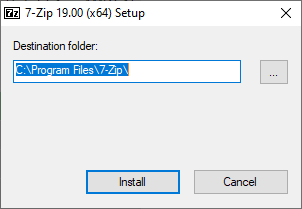
Click “Install” on the setup screen
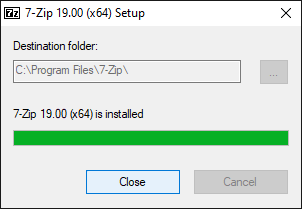
7-Zip will now install, when completed, click “Close“
Preparing an Encrypted 7-Zip File
Single “Right” click on the file
Highlight “7-Zip”
Navigate and “Left” click on “Compress and Email…”
Change Archive Format to “ZIP”
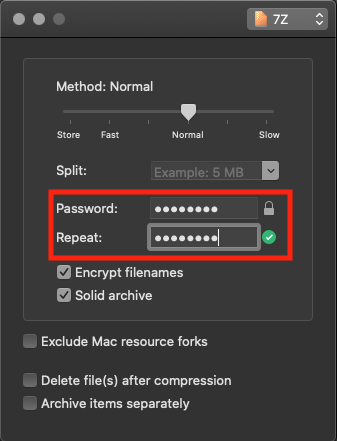
Enter and Retype a password in the “Encryption Section” and check the box to “Encrypt file names”
Change the Encryption Method to “AES-256“
NOTE: The password must be a complex password that contains the following:
At least one capital letter
At least 2 numbers 0-9
At least 1 special character (%, ^, &, ! , @ , !, ….)
Be at least 8 characters long
Click “OK“
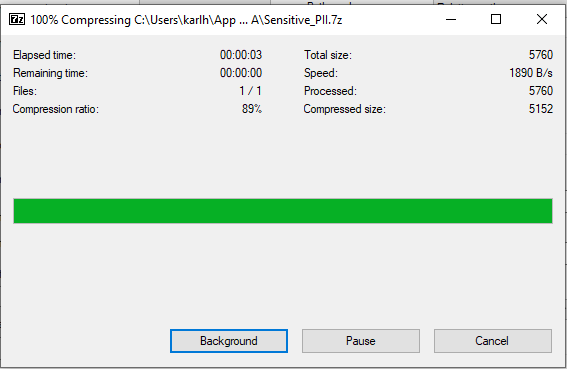
NOTE: A progress bar will open to encrypt and zip the file. Depending on the size of the file, this may take a few minutes.
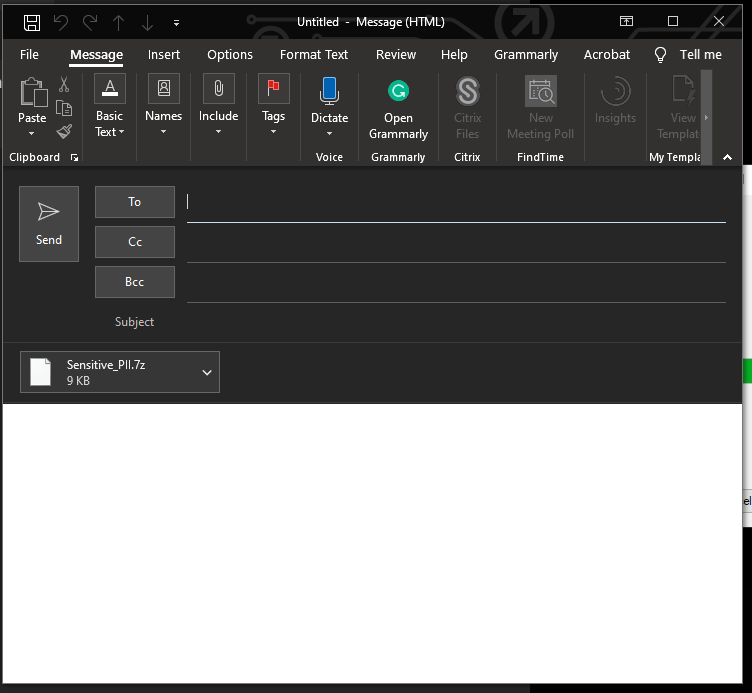
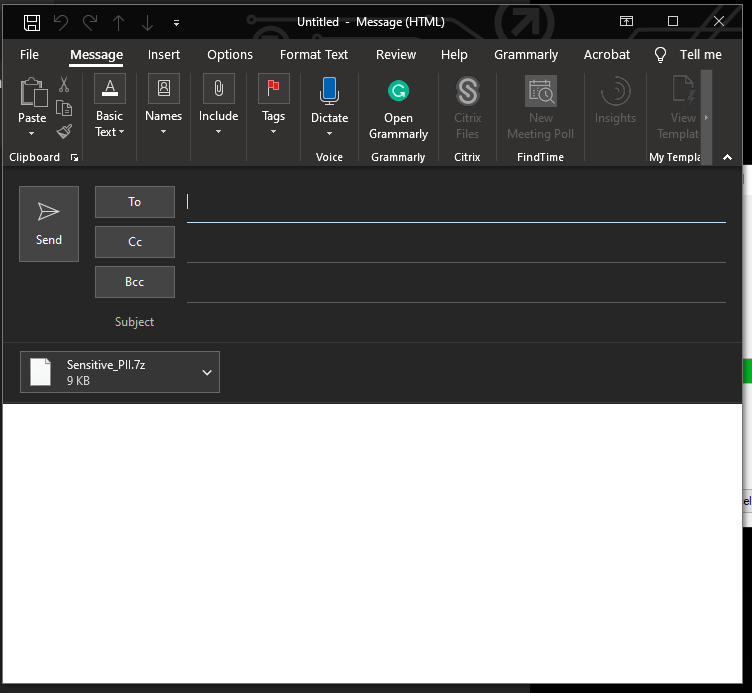
An email message to compose your new email with the compressed and encrypted file will appear
Address and compose your email as desired
CAUTION: Never send an email that contains both the password and file together. These must be sent separately.
Compose and send a separate email, or place a phone call, to the receiving parties which contains the password for the compressed file for them to read
NOTE: Without the password, the receiving party will not be able to open and view the file.
Opening an Encrypted 7zip File
Open the email that contains the encrypted file
Click the arrow “V“’ and select “Save As”
From the saved location open the encrypted file
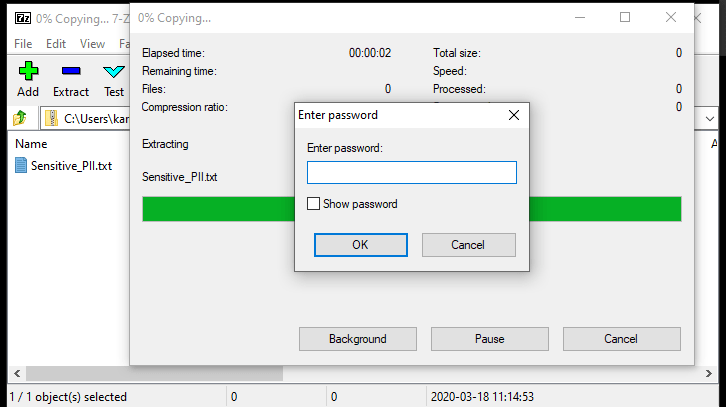
Enter the password provided to you from the sender
Once the password is entered correctly, the enclosed document will then load, and you can make any changes and save inside the protected file. If needed, the file can be returned to the sender with needed information.
NOTE: The Archive Window must not be closed if making any changes that need to be saved.
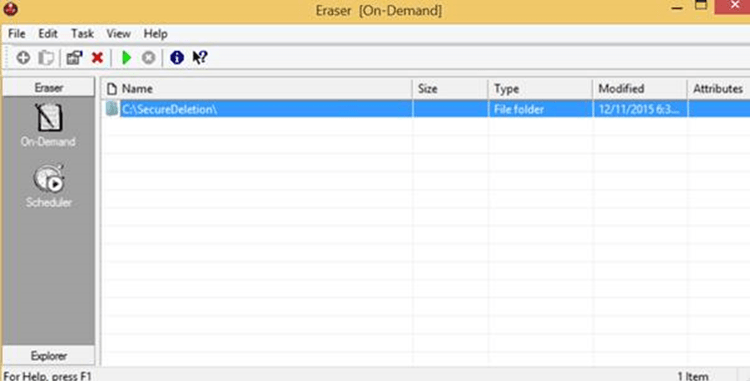
IMPORTANT: After the document is no longer needed, the encrypted file should be SECURELY DELETED from your hard drive. At no time should this be saved for later use.
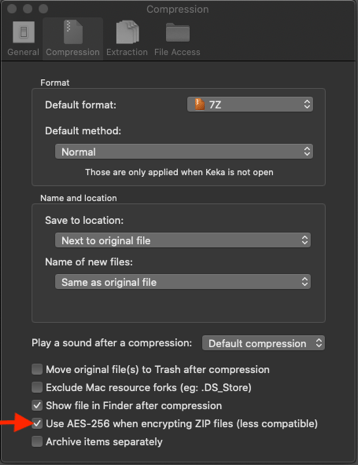
Open Keka Preferences and check the box next to Use AES-256 when encrypting ZIP files (less compatible)
Set a password for the file
Drag your file onto Keka to compress and encrypt. The encrypted file will be placed next to the original file
If you need to extract an encrypted file, simply drag it onto the Keka window and enter the file password in the prompt. The file will be extracted in the same location as the original
Setting up a security key for Duo authentication ensures a higher level of protection for your online accounts. This guide walks you through the process step by step, helping you seamlessly integrate this secure method into your two-factor authentication system.
Compatibility Notice
To ensure compatibility, please use the current version of Google Chrome, Firefox, Safari, or Microsoft Edge. Legacy devices that are incapable of receiving browser updates will be unable to authenticate via security key. To ensure that you can still authenticate to these legacy devices and to other potentially incompatible applications, we ask that you keep Duo Push active as a secondary authentication method.
Setting up a Security Key for DUO Authentication
Visit 2fa.fdu.edu and log in using your NetID username and password
When prompted by Duo authentication, select “Send Me a Push” or select your preferred authentication method and authenticate
Plug your security key into an available USB port on your computer
Tip
All FDU-issued laptops are equipped with USB-C connections. If your device does not have a USB-C port, you can use a USB-C to USB-A adapter to connect the security key.
Once the security key is connected, select “Add Another Device”
Select “Security Key” and click “Continue”
Click “OK” on the security key setup screen
Click “OK” on the Continue Setup screen
Press the button on your security key when prompted
To set the security key as your default device:
Select “Security Key” from the Default Device dropdown menu
Click “Save”
Recommended Security Keys
For enhanced security and seamless integration with Duo authentication, we recommend purchasing Yubico NFC security keys. Yubico offers both USB-C and USB-A versions to suit your device’s port compatibility.
FDU’s VPN Client Software, is also known as the “Cisco AnyConnect Secure Mobility Client”.
Use any web browser (Google Chrome, Mozilla Firefox, Safari) to navigate to vpn.fdu.edu. Please refrain from using the Internet Explorer web browser when installing the FDU VPN Client
Select your role within the University from the Group pulldown menu and enter your NetID Information in the username and password fields (user@fdu.edu)
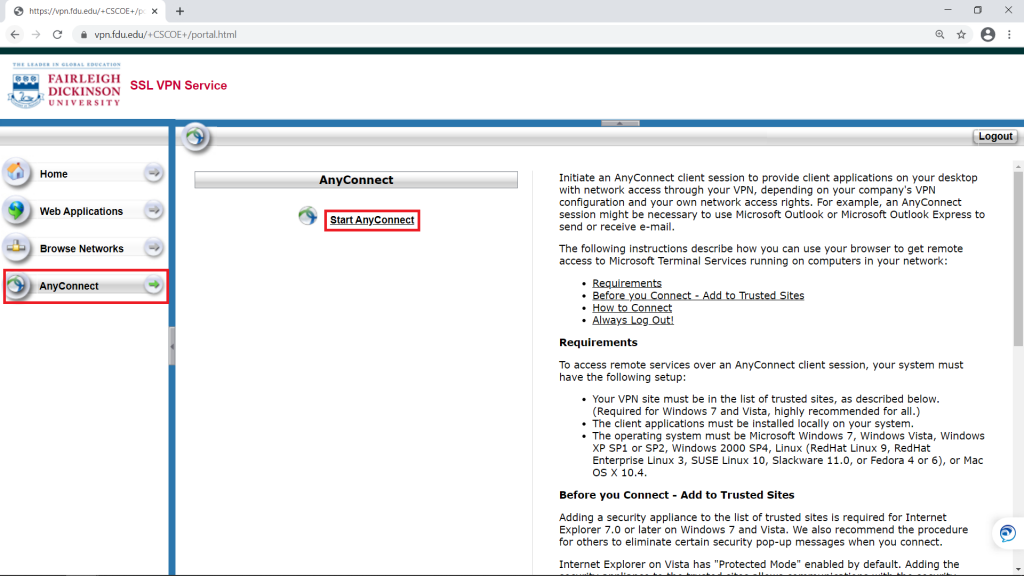
On the left-hand side menu, click on “AnyConnect“, then click on “Start AnyConnect”
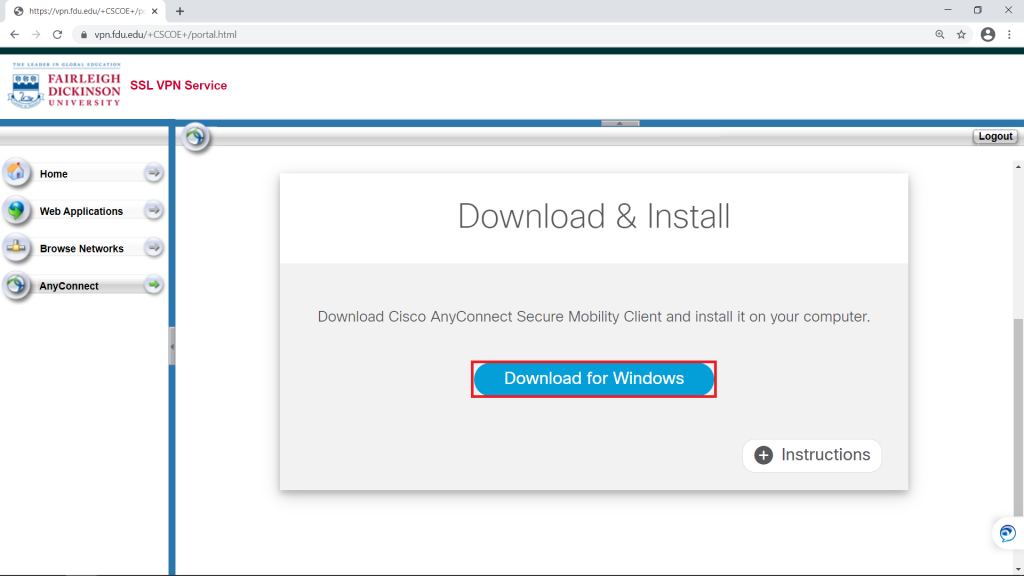
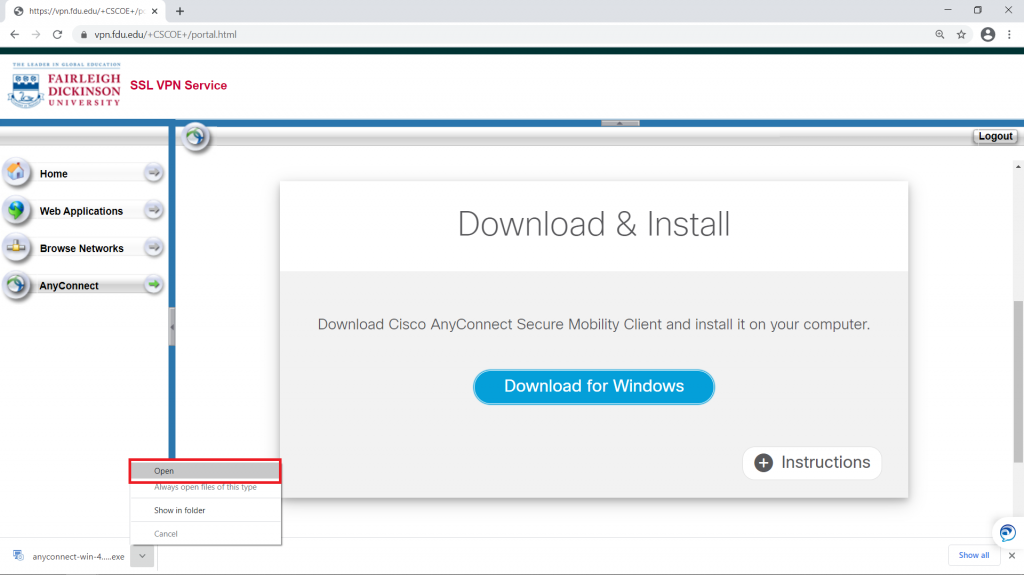
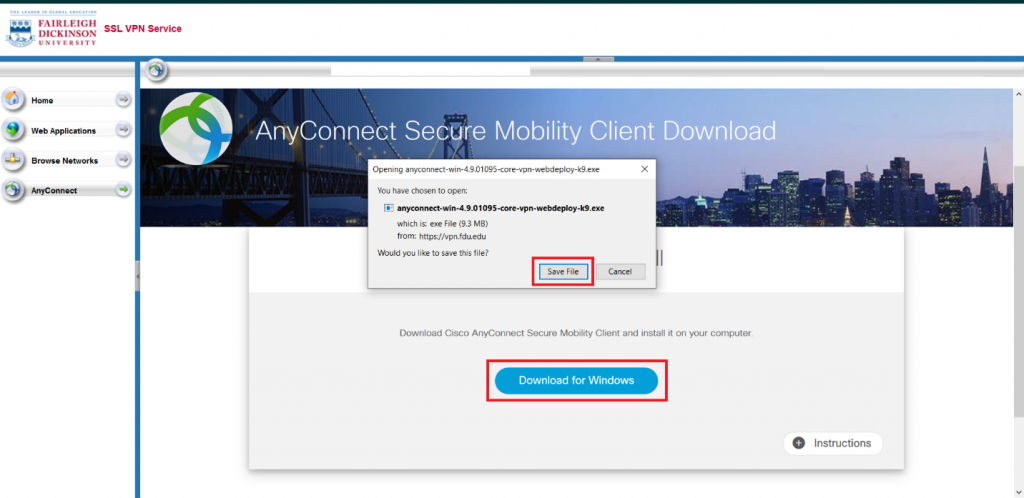
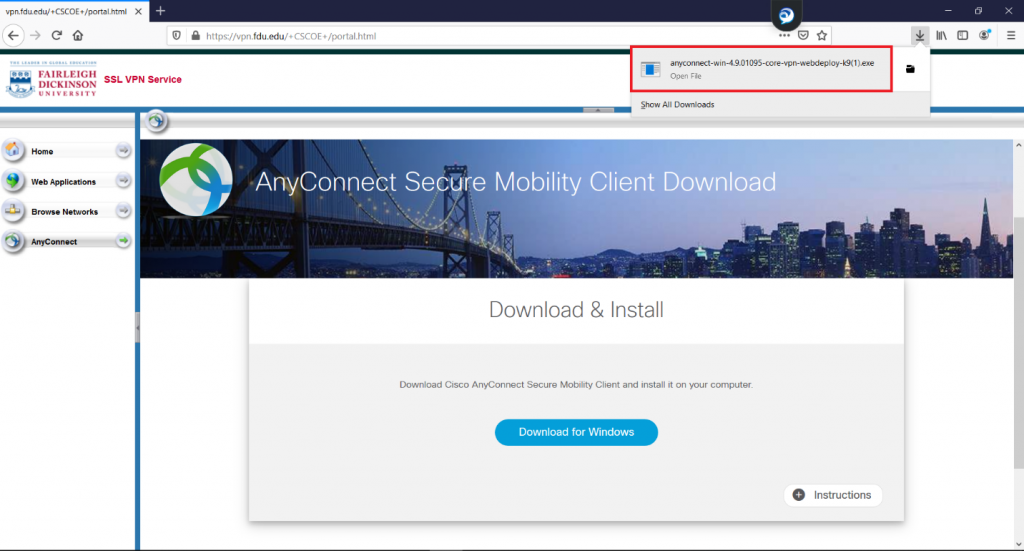
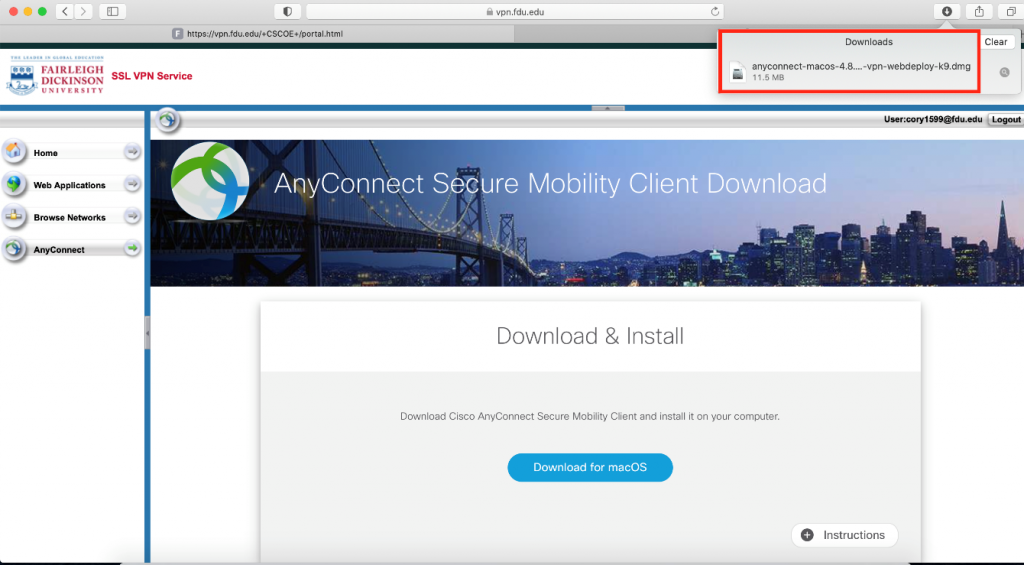
Download the VPN applet by clicking on “Download for Windows” or “Download for macOS” depending on your operating system. The browser will then download the VPN software client. When finished downloading, click on the file and select “open” within your browser
Chrome
Firefox
Safari
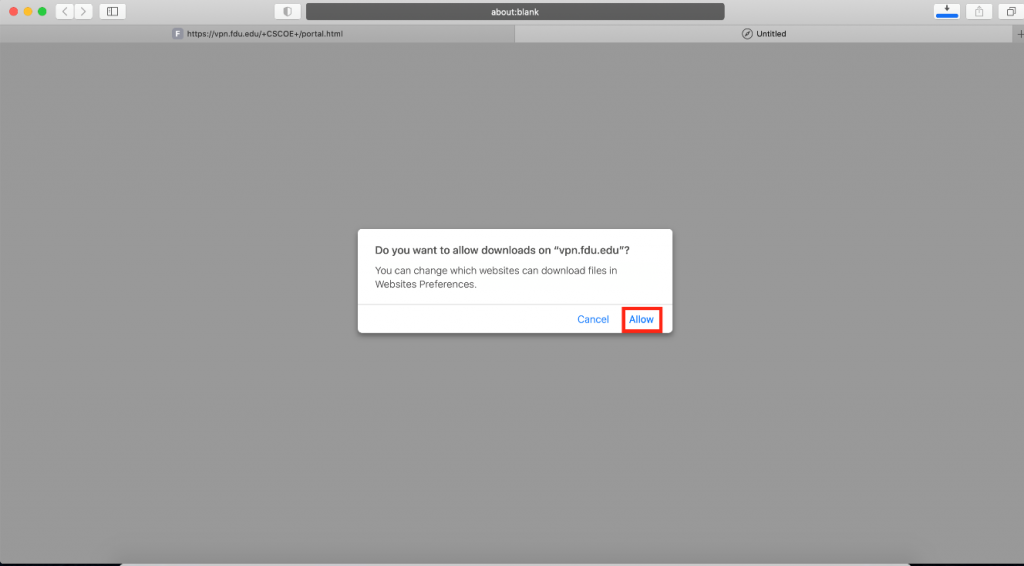
The browser will open a new window asking for permission to download the applet, click on “Allow”. When finished downloading, double click on the file to open the installation package and start the installation process.
Follow the steps prompted to accept all changes and grant requested permissions to install FDU VPN software. Note, Java Runtime Environment software may also need to be installed. A copy of the software download will be prompted to be installed or can be accessed using the link below:
The installation will continue, and an icon for the “Cisco AnyConnect Secure Mobility Client” with a “lock” icon will appear in your system tray once the installation is complete
close
Configuring The FDU VPN
Log into your computer
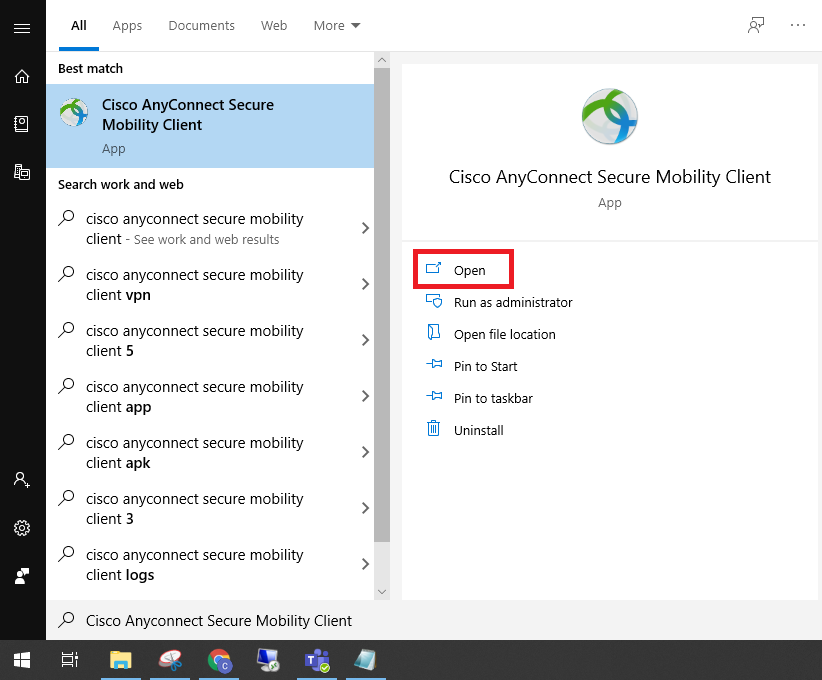
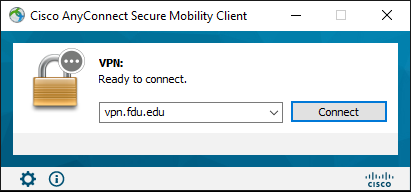
Launch the Cisco AnyConnect Secure Mobility Client from the Start Menu. Ensure the address “vpn.fdu.edu” is entered into the corresponding text box and then press the “Connect” button
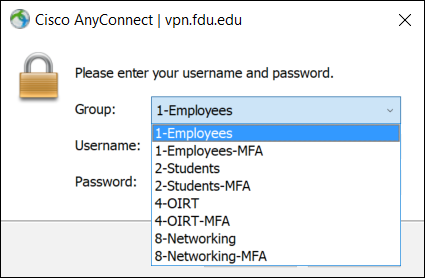
Select your correct Group name on the dropdown menu, then enter your FDU NetID username and current FDU NetID password in the corresponding boxes. Click “OK“
Dropdown Options
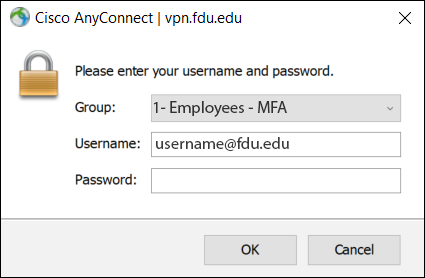
Example for Employees
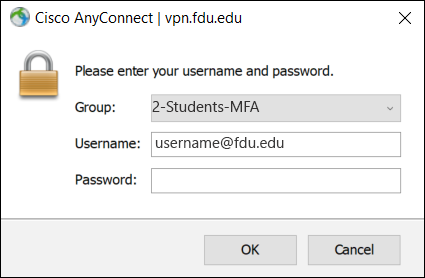
Example for Students
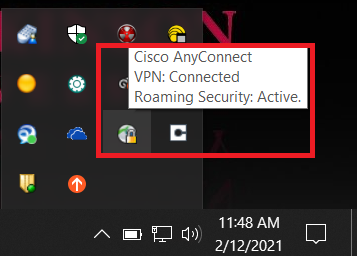
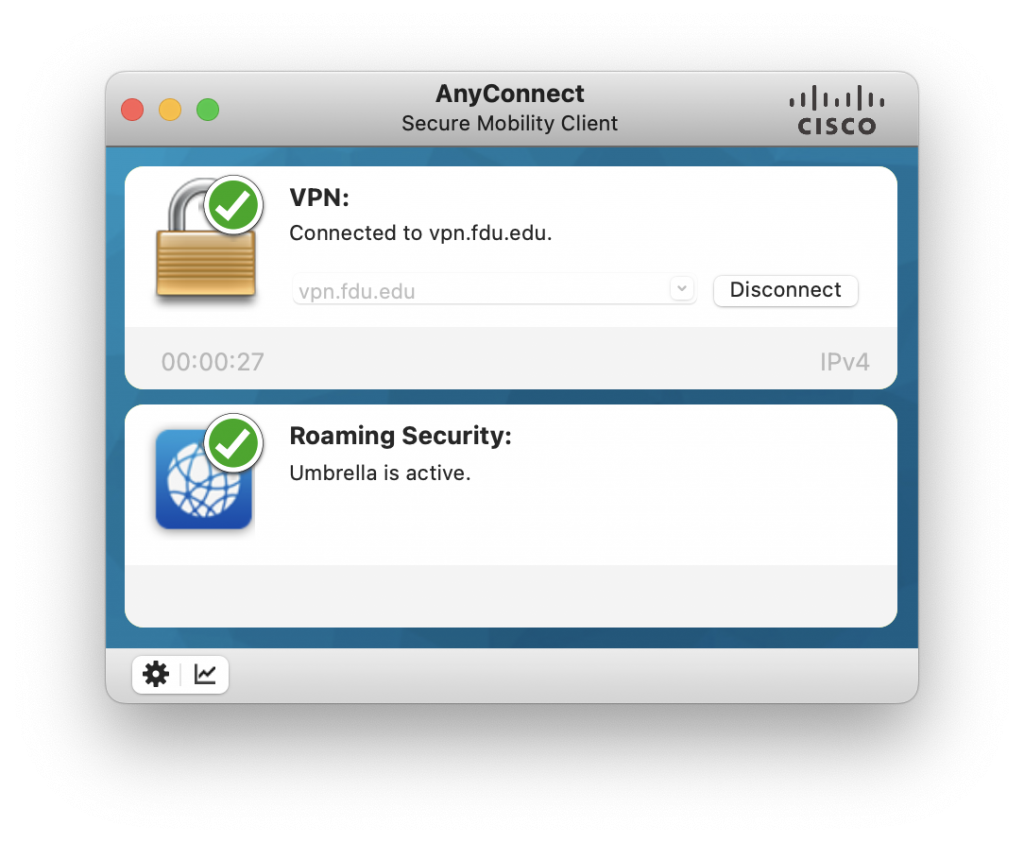
Ensure a successful connection was made by checking on your system tray at the bottom right portion of your screen, or if on macOS, the client application window will display a screen check over the lock icon
Windows
macOS
close
Logging into The FDU VPN
The following instructions are the same for both Windows and macOS users.
Register with Duo MFA
If you are an existing Duo user, please skip to Step 2
For new Duo users, please follow the guide below for registering your DUO Account
Launch the “Cisco AnyConnect Secure Mobility Client” from the Start Menu or your Mac’s application folder if on macOS
Ensure the address “vpn.fdu.edu” is entered into the corresponding text box and then click the “Connect” button
Select your correct Group name on the dropdown menu
Enter your FDU NetID username and current FDU NetID password in the corresponding boxes. Click “OK”
Example for Employees
Example for Students
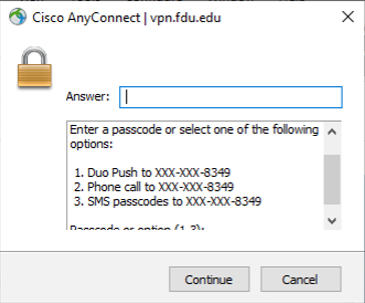
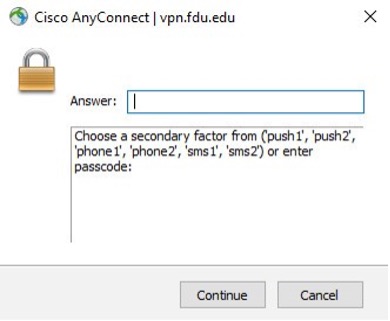
In response, you’ll receive the Duo challenge dialog box. To use the preferred method type push in the Answer: dialog box, then click “Continue“
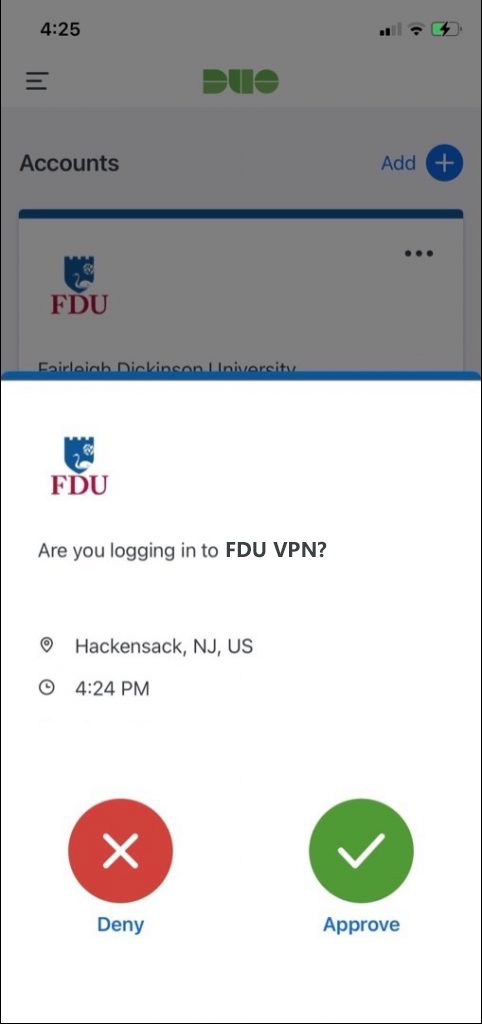
Tap “Approve” on the Duo login request received at your phone
Ensure a successful connection was made by checking on your system tray at the bottom right portion of your screen, or if on macOS, the client application window will display a screen check over the lock icon
Windows
macOS
Additional DUO Information
Users with multiple registered Duo devices will need to enter push1 for their primary device or push2 for their backup device. If you are unsure which device is your primary or secondary device, open the Duo Mobile app on your mobile device, click Fairleigh Dickinson University and enter the passcode displayed.
Additional DUO Authentication Options
Type
Instructions
Push (Preferred)
Push a login request to your phone (if you have Duo Mobile installed and activated on your iOS or Android device). Review the request and tap “Approve” to log in.
Have Duo call your phone to authenticate your login.(Users with multiple devices will need to include a number indicating desired device i.e. Phone2). This option is only available to Faculty, Staff and approved Students.
SMS
Have Duo text a passcode to your phone. (Users with multiple devices will need to include a number indicating desired device i.e. SMS2).
NOTE: This option is only available to Faculty, Staff and approved Students.
Sign in to the FDU Single-Sign-On (SSO) page using your FDU NetID credentials
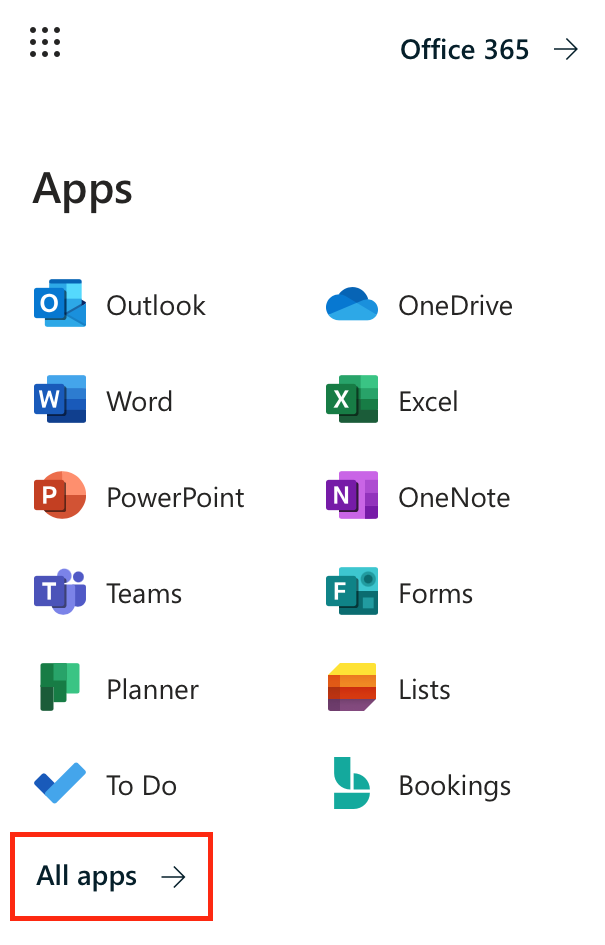
In the upper left corner, click the dotted square and select All Apps
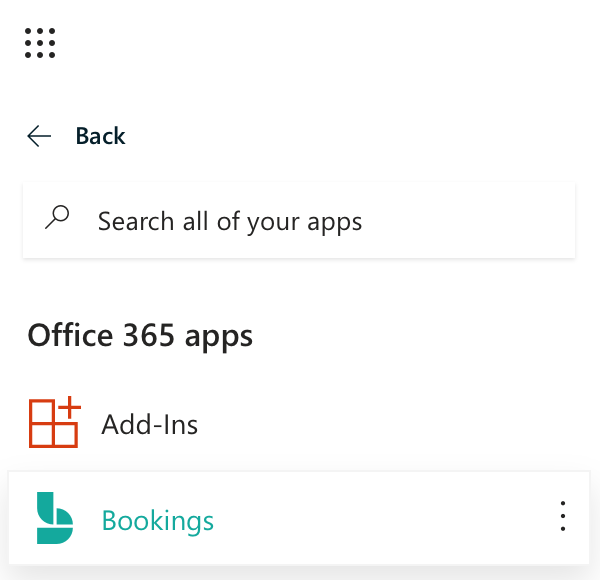
In the All Apps menu, choose Bookings
Microsoft Bookings will open. Click the Get it Now button to begin
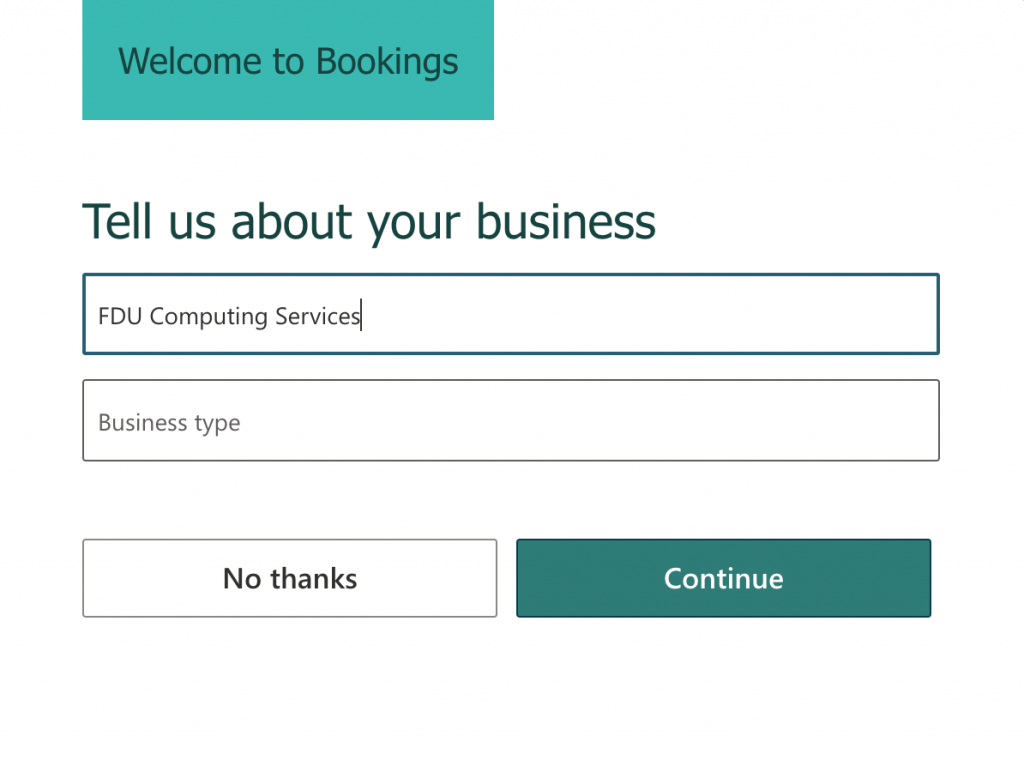
The next page will ask for two pieces of information: Business nameandBusiness type. Enter your Department name or your First and Last Name. Click Continue
Note
Designating a Business Type is not required to be able to Continue.
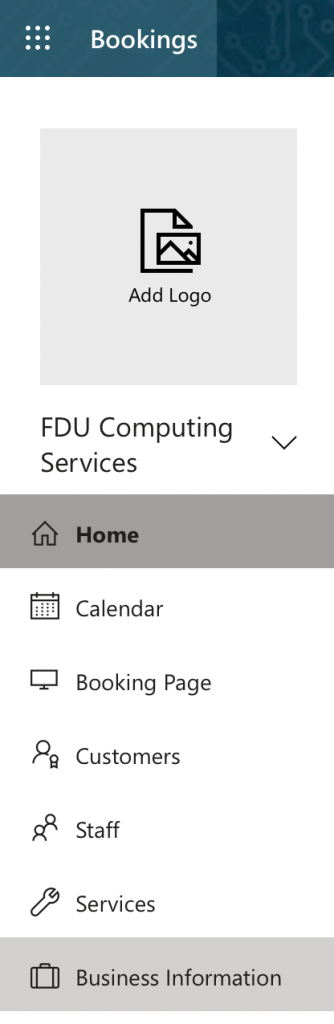
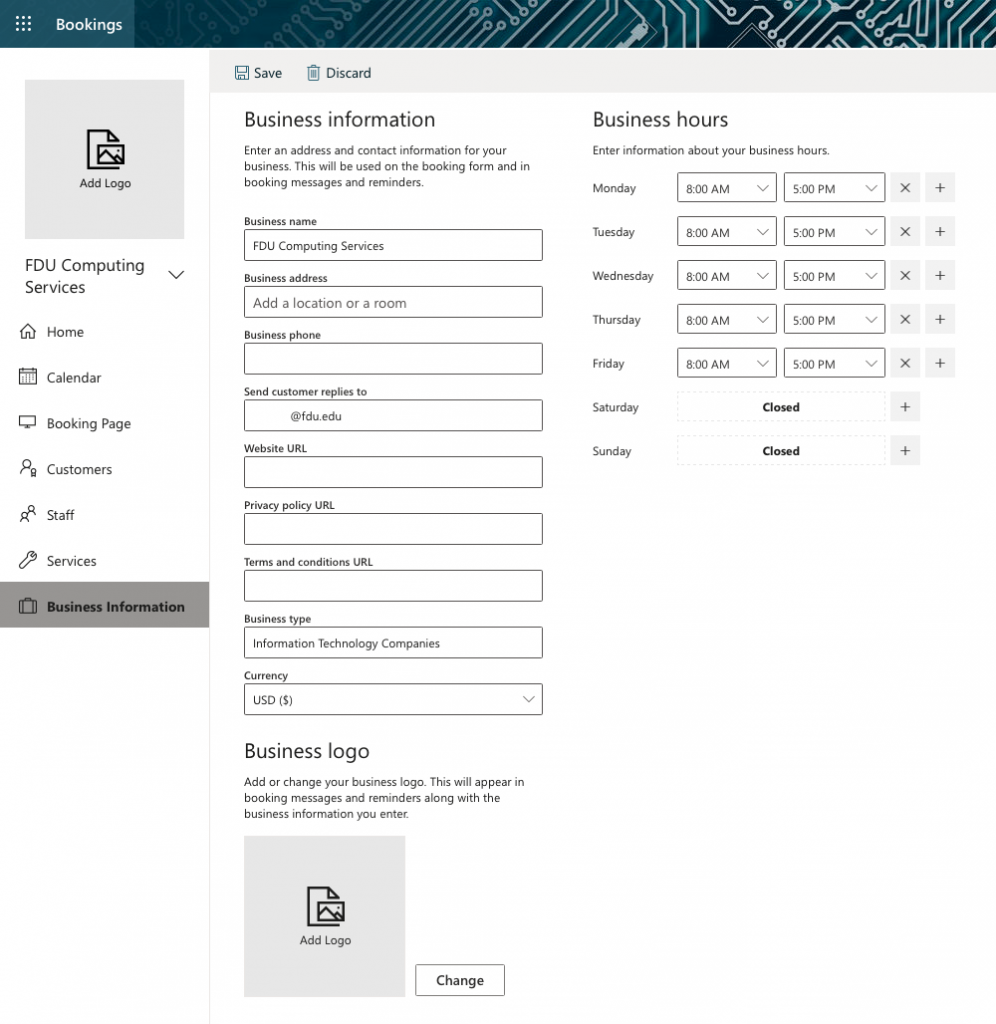
Once your Bookings page loads, the first section you should complete is Business Information. Click Business Information in the left menu
On the Business Information page, you can enter your business or department address, other contact information, upload a business logo, and set up your business hours
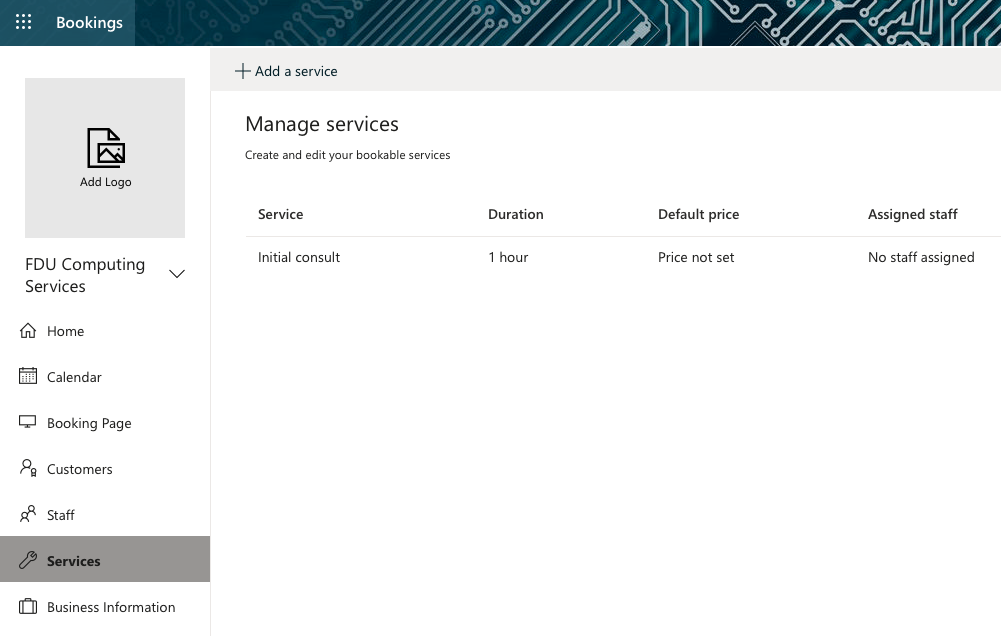
Next, set up your service offerings. Click Services from the left menu
Note
By default, Microsoft Bookings will add a service called “Initial Consult.” You can click the pencil next to this service and make it your own, OR you can add a new service by clicking Add a service at the top of the screen.
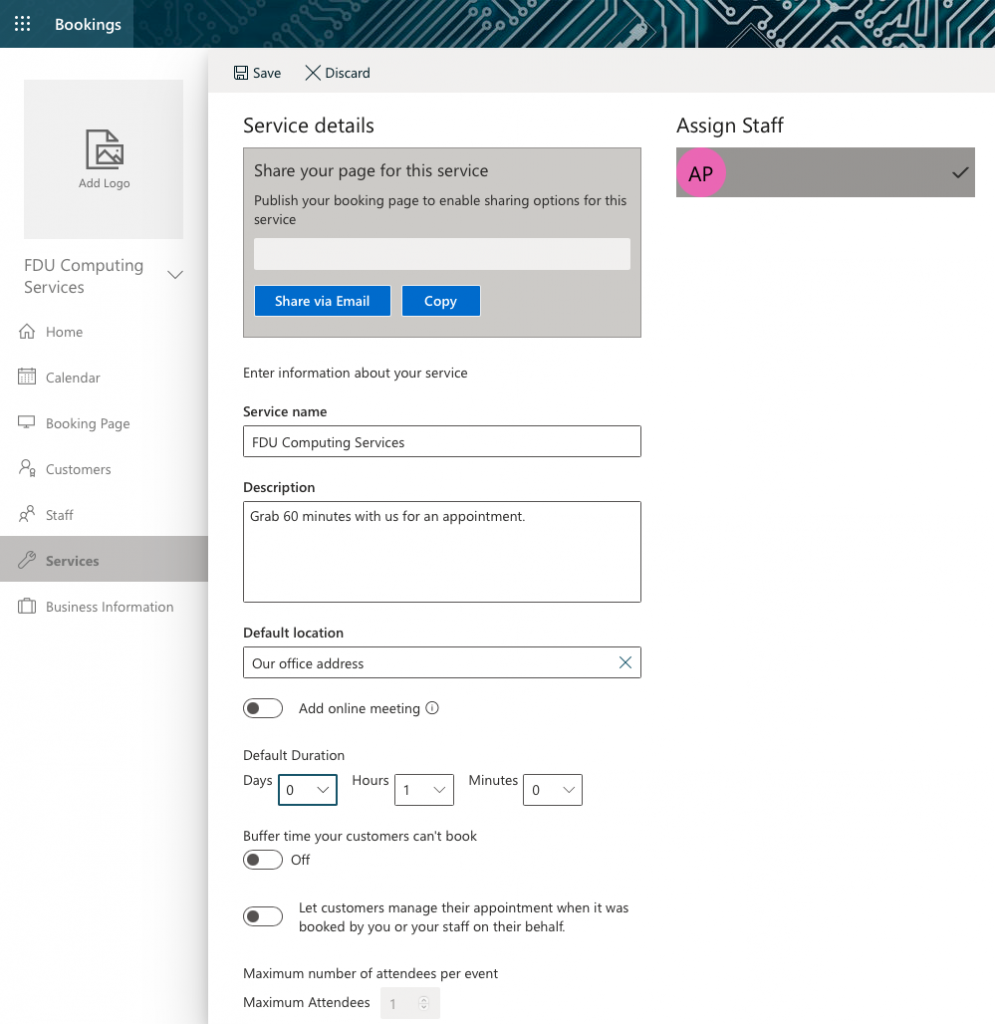
Once you’re on the service-editing page, enter your service details, including name, description, and location. When you start typing an address in the default location, suggested locations will populate. Below are explanations for the other fields on the service-editing screen:
Duration: You can enter how long you want the duration to last in days, hours, minutes, and set a buffer time when customers cannot book.
Reminders: You can have the system send customers email reminders before their scheduled appointment. Click the pencil to edit the text.
Leave Publishing options checked.
Online Scheduling Options: This is where you can manage the settings for when customers can book services.
You can choose to use the default scheduling policy by leaving the option checked, OR
You can manage the settings for your scheduling policy by unchecking the option. If you choose this option, we recommend setting the Minimum lead time to 24 and the maximum lead time to 30 days.
Don’t forget to click Save at the top of the Service details page
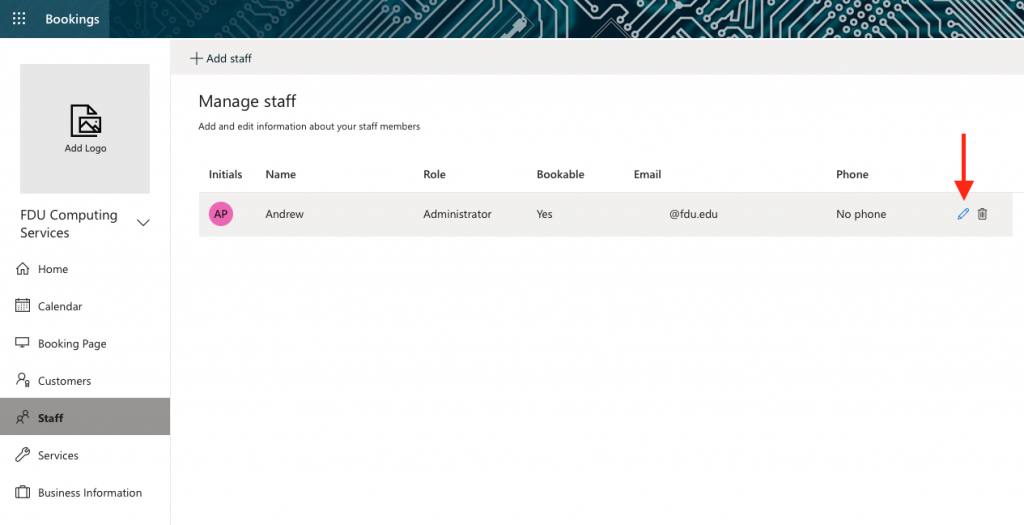
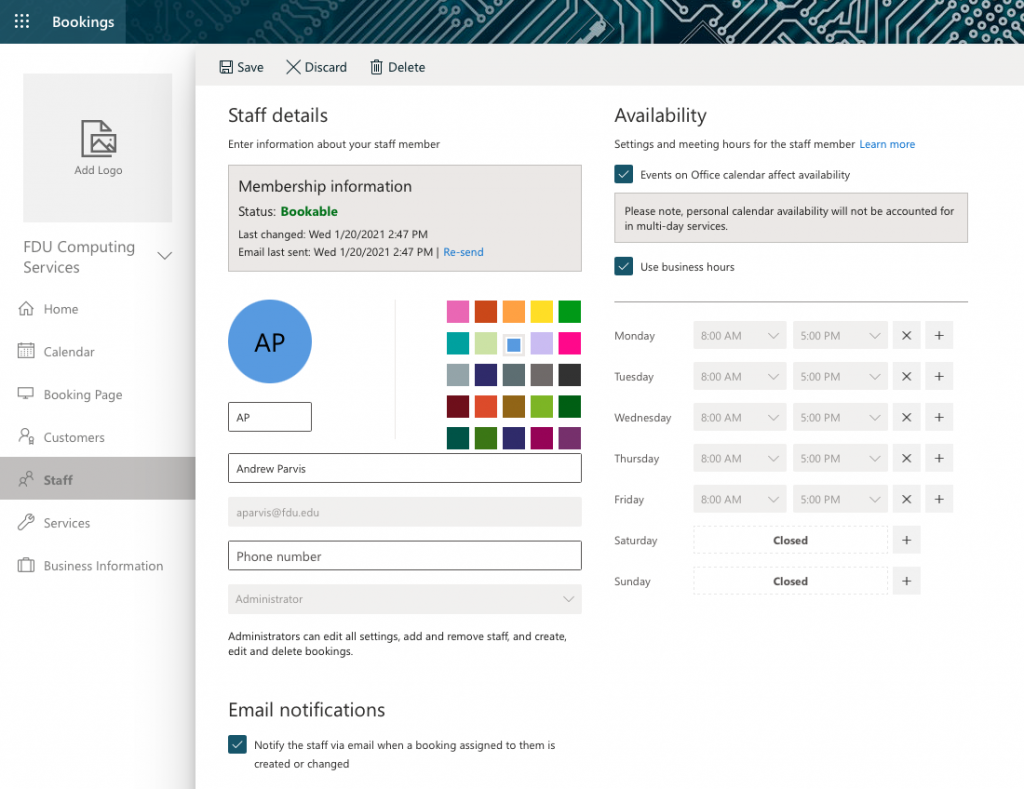
Next, click Staff from the left menu. Click the pencil next to your name to edit your information. Also, you may add any staff or faculty members in your department by clicking the + Add staff button
On this page, you can add information about yourself, including your office or department phone number and whether to receive email notifications (we recommend keeping this option checked). Click Save when finished
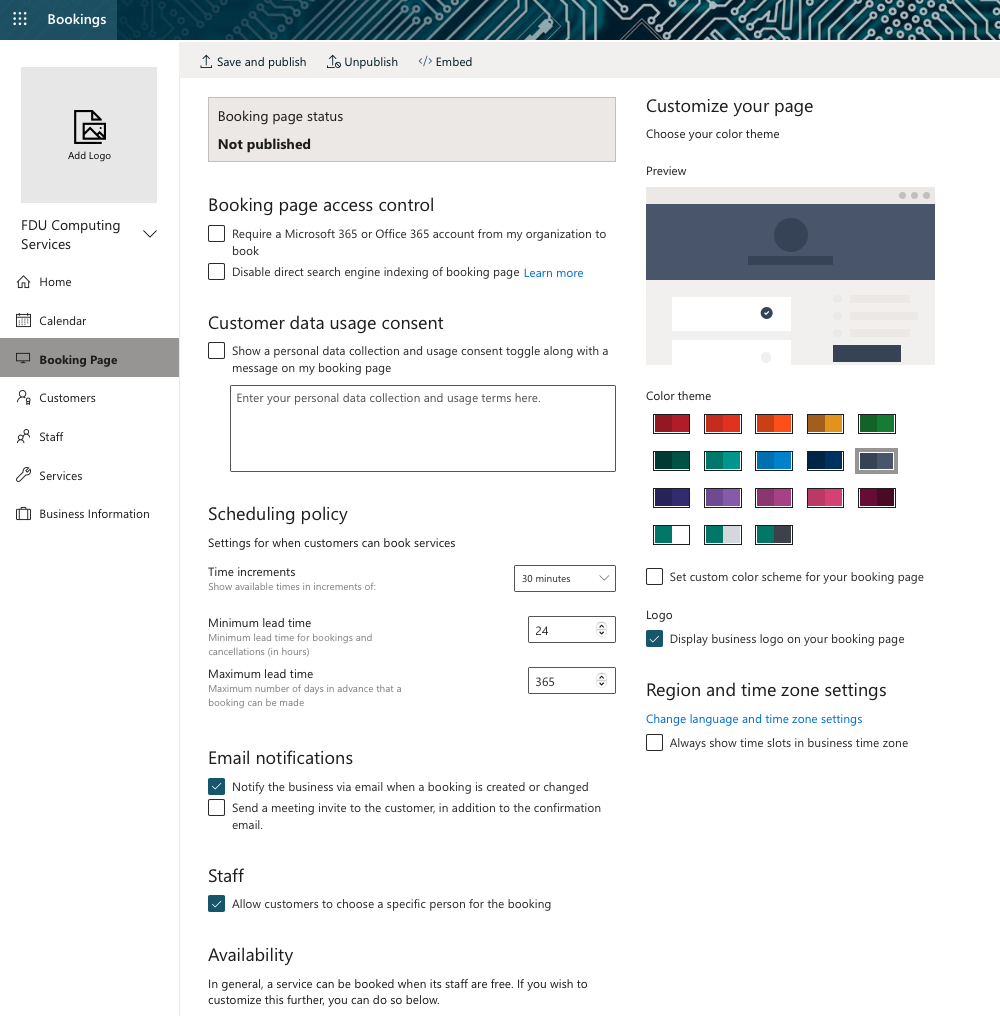
Next, select Booking page from the left navigation pane.
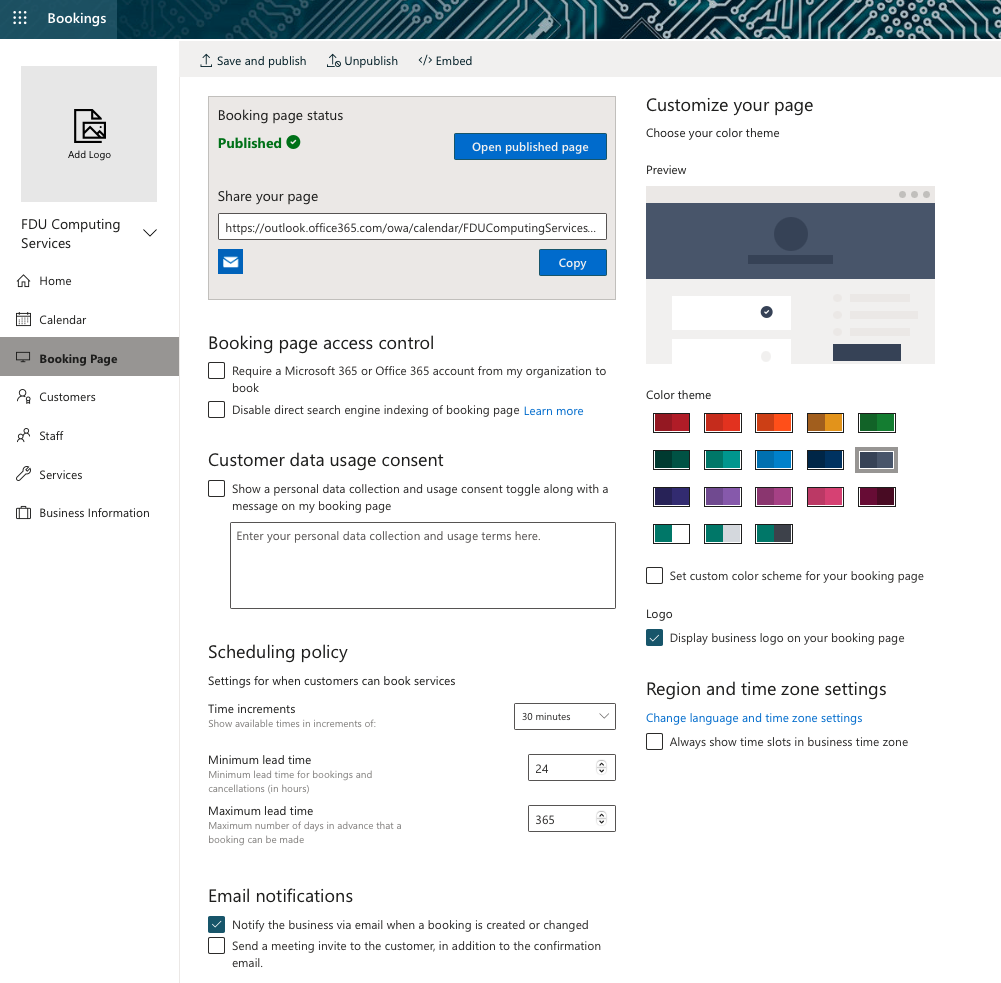
Booking page Status: Since this is the first time you are setting up your Bookings page, your status is set to Not published. Once you finish customizing your page and clicking Save, the status will change to Published.
Customer data usage consent (optional): Where you can customize a message for your visitors to consent to your site collecting their personal data.
Scheduling Policy: Where you can set site-wide scheduling policies. We recommend the following settings:
Minimum lead time: 24
Maximum lead time: 30
Email Notifications: Notifies you when an appointment is made.
Staff: You can allow customers to choose who they want to meet with. However, you can uncheck this option if you do not have any staff.
Customize your page: Choose a color theme for your bookings page.
Lastly, click Save and Publish
Once you click Save and publish, your Bookings site is now live! You can view your published page by clicking Open published page and share your page with others by copying the link
A shared mailbox makes it easy for a group of people to read and send emails from one public email address, like info@fdu.edu. When a person in the group replies to a message sent to the shared mailbox, the email appears to be from the shared address, not from the individual user. Shared mailboxes can also be used to provide a shared calendar, allowing multiple users to schedule and view calendar tasks.
Request Access to an FDU Shared Mailbox
Users can request a new shared mailbox by completing and submitting the “Distribution Group/Shared Mailbox Request” form found below. Users needing access to a specific FDU shared mailbox account may request access by reaching out to the shared mailbox owner. To fulfill this request, the shared mailbox owner will open a support case with the Fairleigh Dickinson University Technical Assistance Center (UTAC).
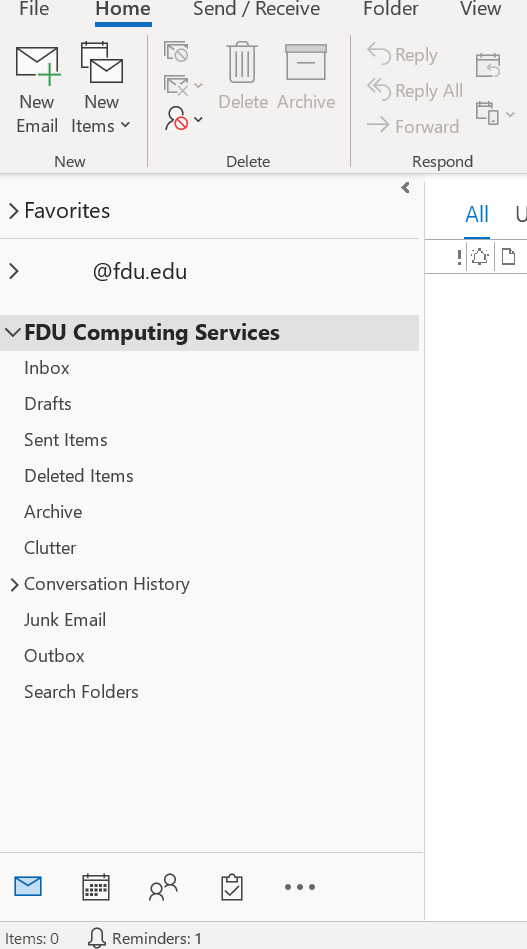
The shared mailbox should automatically display in your folder pane on the left-hand side of your Outlook application within 24 hours of its creation. Closing and restarting the Outlook application maybe necessary if you do not see it after 24 hours
Note
Before you can use a shared mailbox, the Microsoft 365 admin for the university has to add you as a member.
Some macOS users may take advantage of the “New Outlook” version of the Outlook application. You can identify which Outlook version you are using by locating the “New Outlook” slider tab button on the top right of the application.
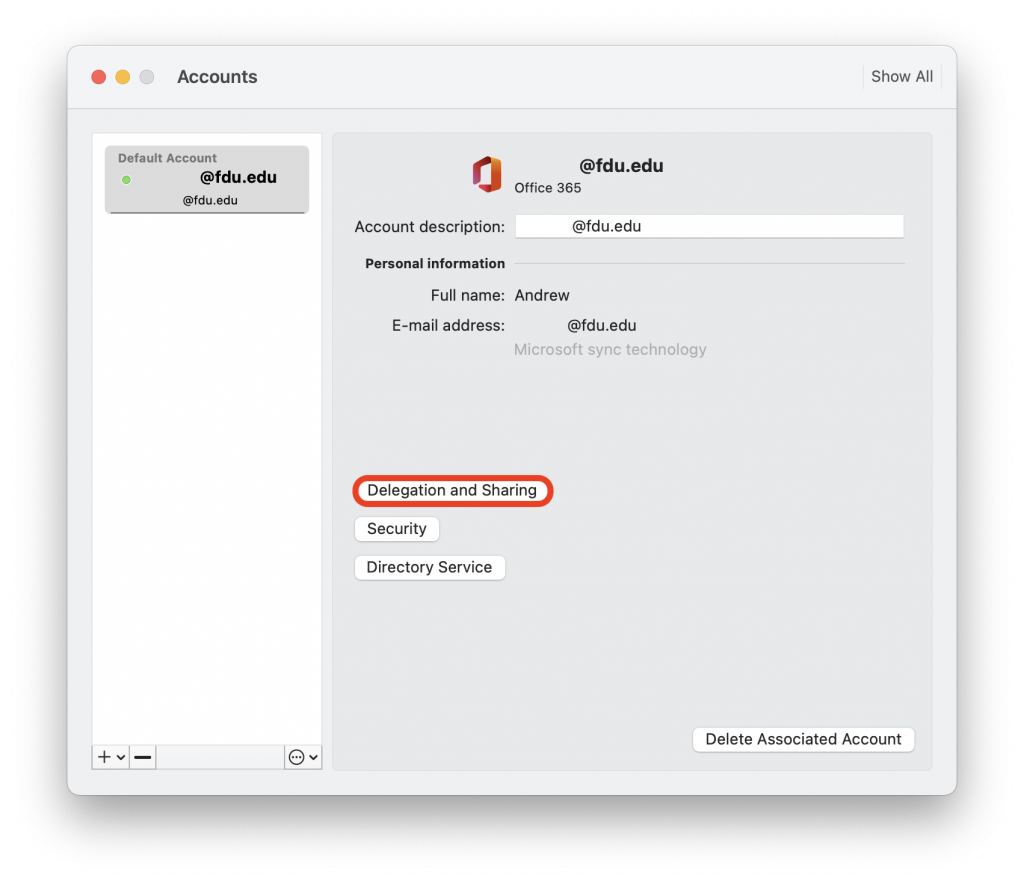
Select Tools from the Outlook menu at the top of the screen, then choose Accounts
Select the Delegation and Sharing tab
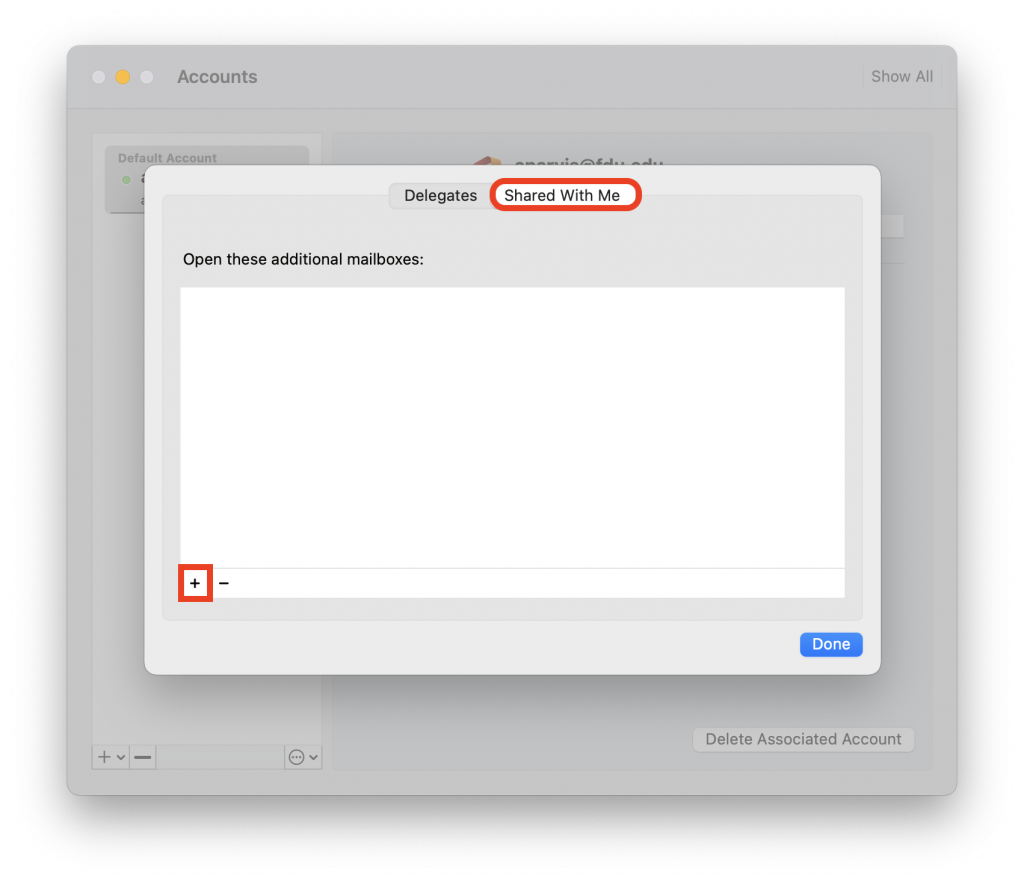
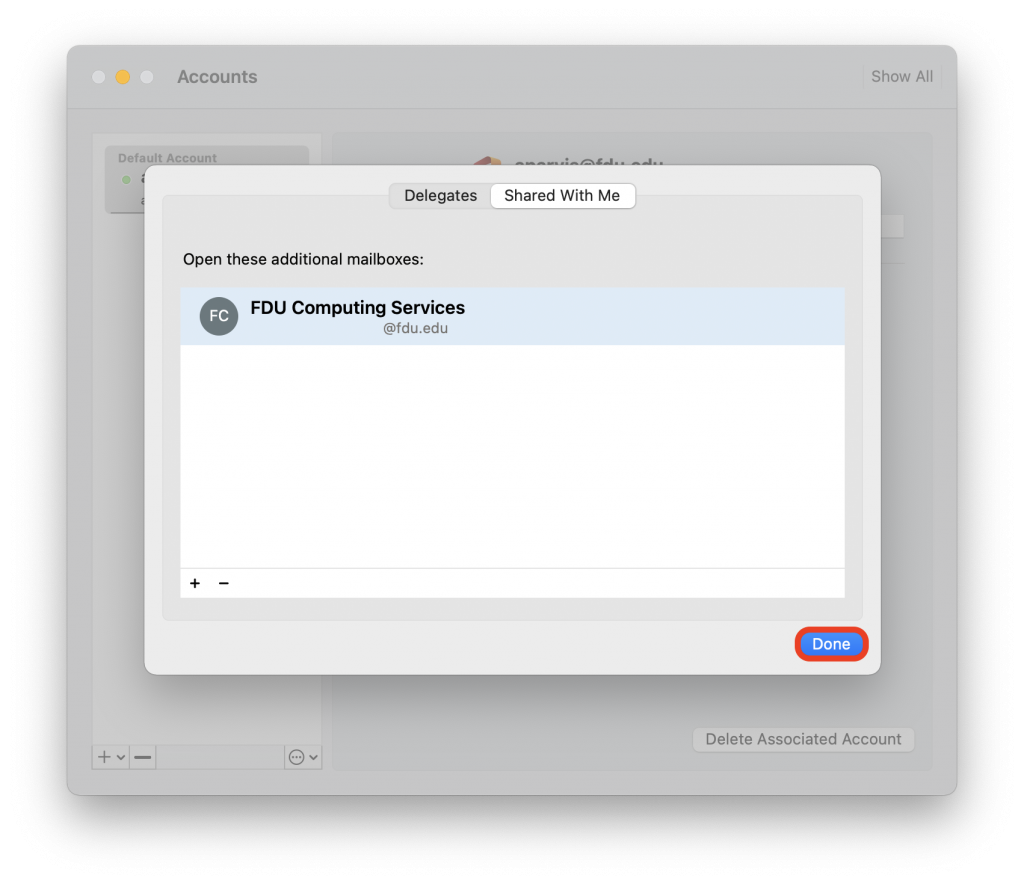
Choose the Shared With Me tab and then select the + button
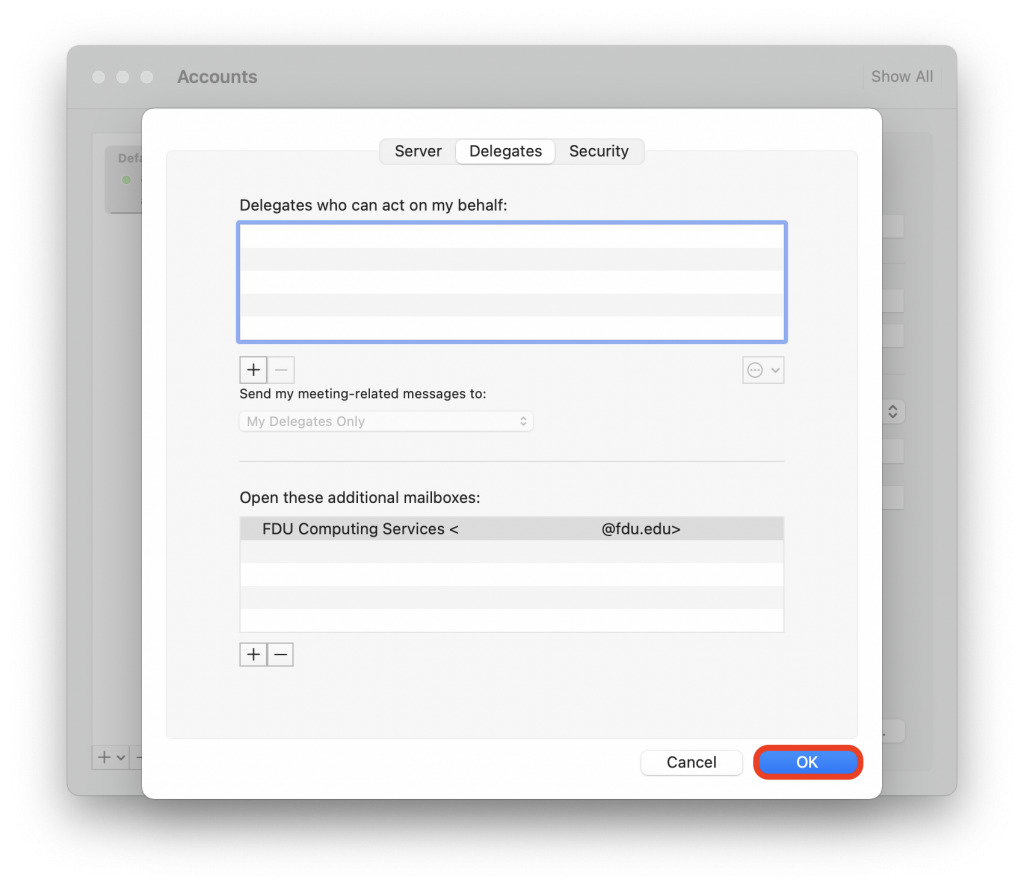
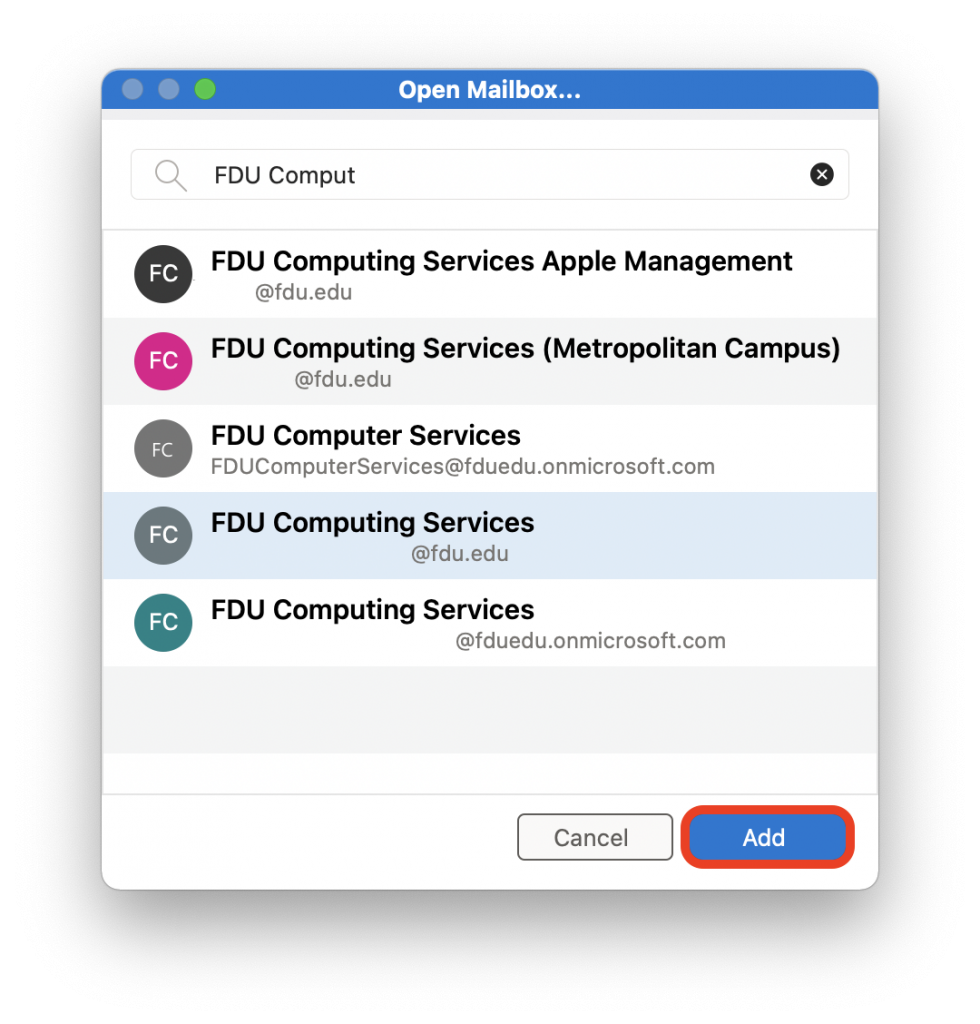
Begin to type the shared mailbox name or its email address, choose the correct shared mailbox before selecting Add, and finally Done when finished
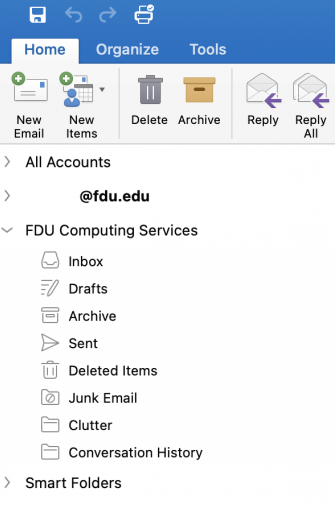
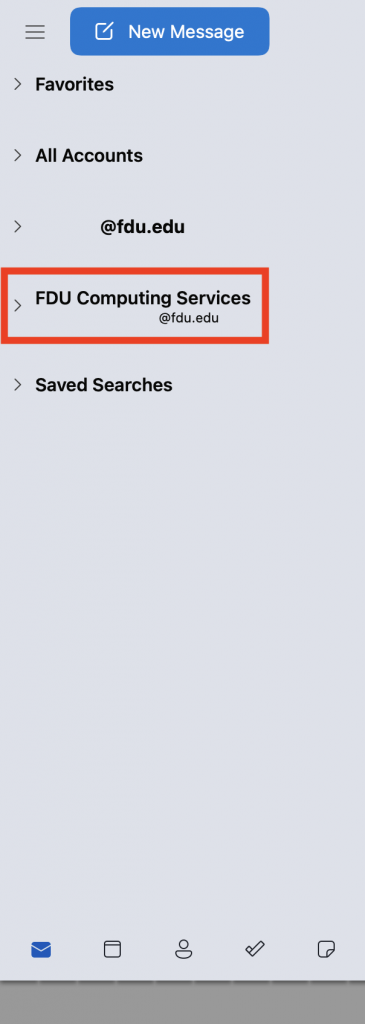
You should now see your shared mailbox, located on the left-hand side of your Outlook application window
Note
This is a one-time process only. You do not need to follow the above steps to add this to Outlook on your macOS device again.
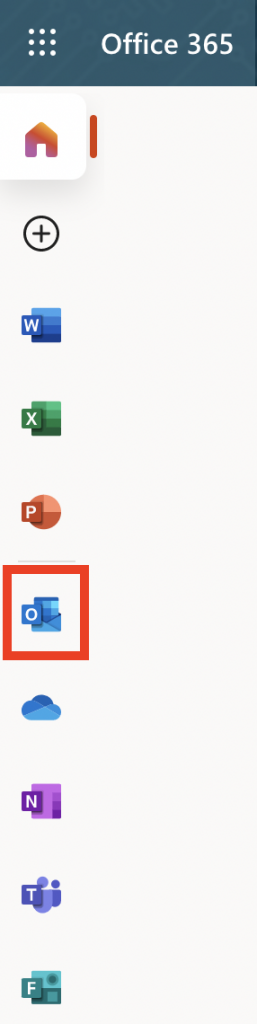
Select the Outlook web app icon, located on the left-hand side of your display
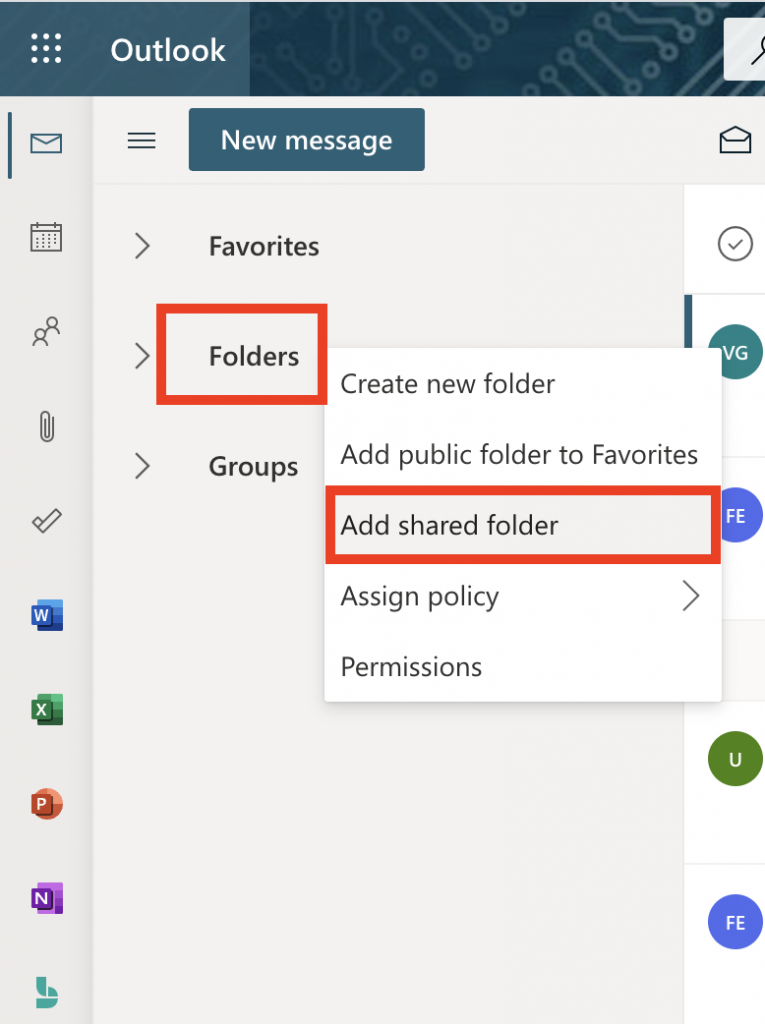
Right-click on the Folders option located on the left side of the menu; a small drop-down menu should display. Select Add shared folder
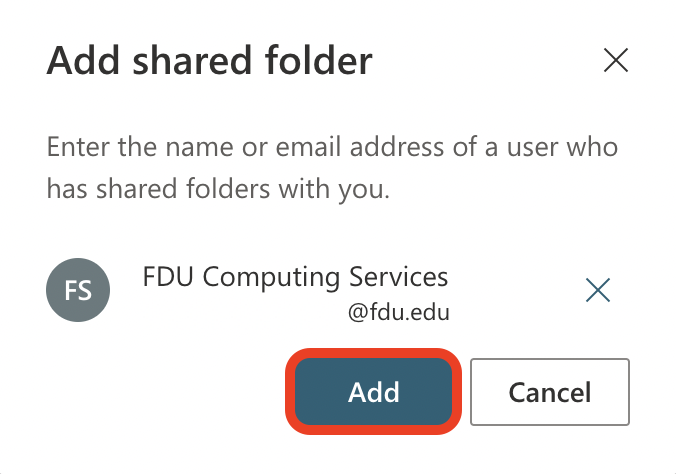
Begin typing the email address for the shared mailbox, auto-populated suggestions will be displayed. Select the correct shared mailbox address and click Add
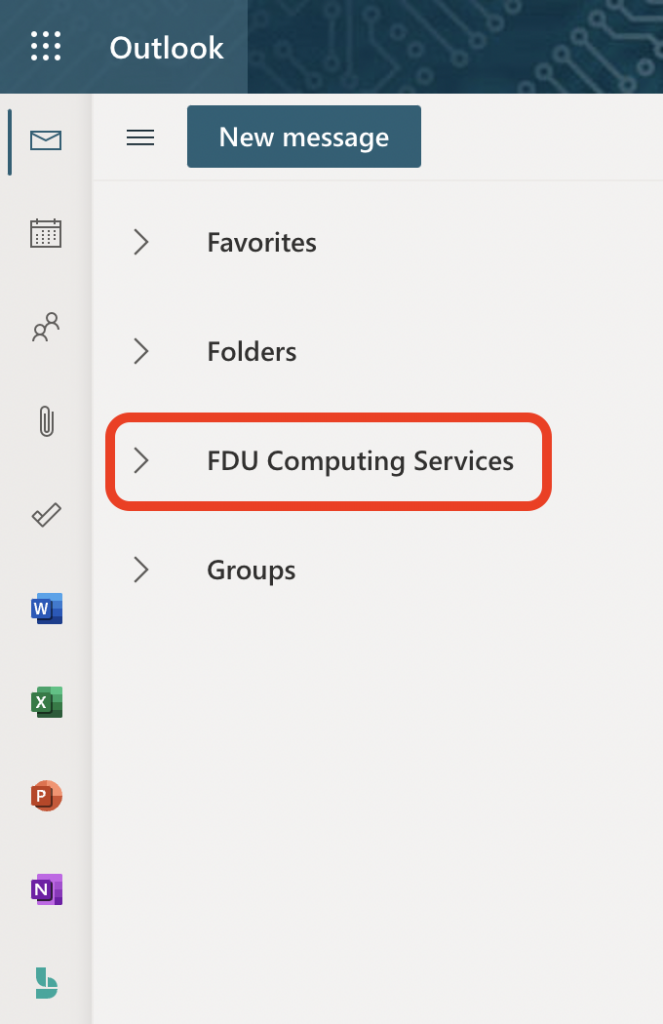
You should now see the added shared mailbox located on left side of your Outlook web email window
Note
This was a one-time process. You do not need to follow the above steps to add this to your account again. You will automatically see the shared mailbox when you sign in to your account next time.
Sign in to your primary FDU email account in the Microsoft Outlook for Android or iOS app
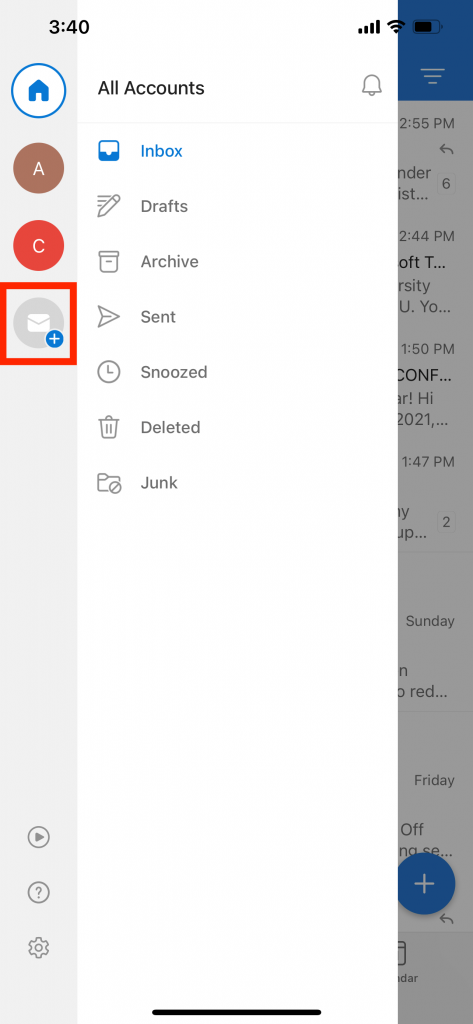
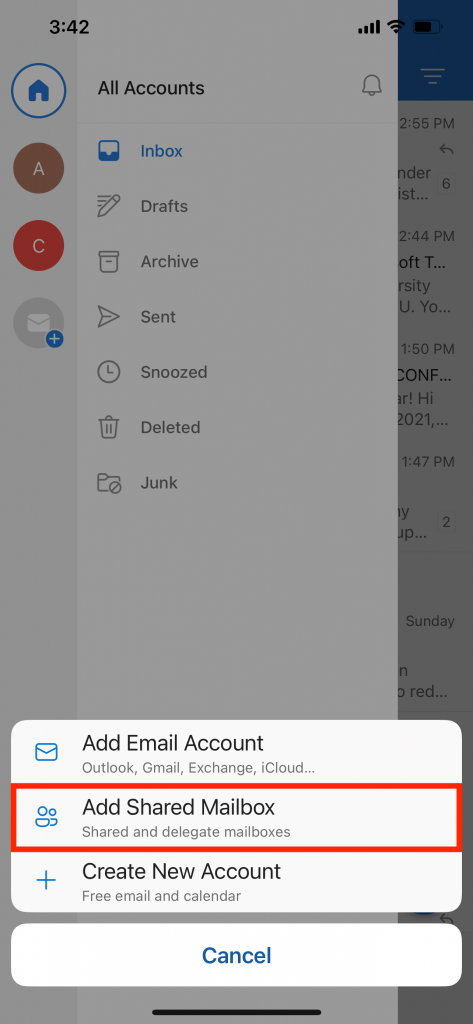
Tap the Add Account button in the left navigation pane, then tap Add Shared Mailbox
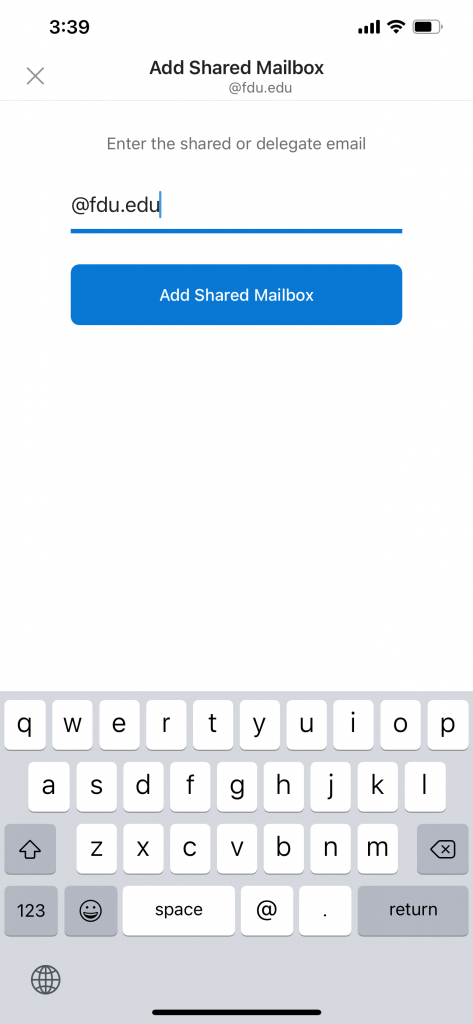
Enter the name of the shared mailbox and tap Add Shared Mailbox when finished
Note
If you have multiple accounts in Outlook Mobile, select the account that has permissions to access the shared mailbox.
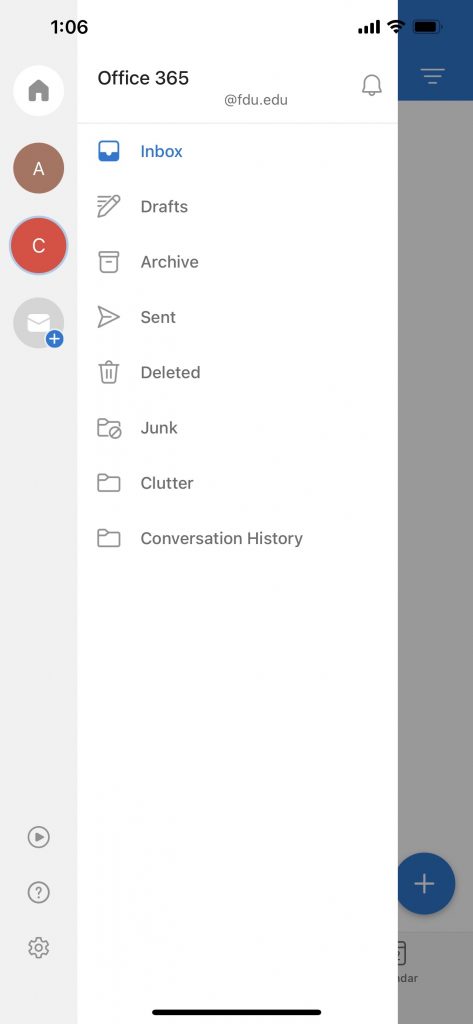
After the account setup process completes, the shared mailbox will display in your account list within the Outlook for Android or iOS app
Tip
To remove a shared mailbox, go to Settings > Accounts. Then tap on the shared mailbox and select Delete Account.
close
Send Email from a Shared Mailbox
Windows / macOS
Open Outlook
Choose New Email to start a new message
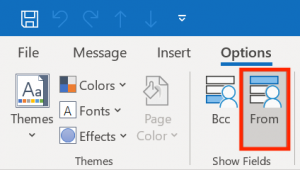
If you don’t see the From field at the top of your message, choose Options, and select the From tab
Click From in the message, and change to the shared email address
Note
If you don’t see your shared email address displayed, choose “Other email address…” Enter the full email address for the shared mailbox in the blank or search for the email address by clicking “From” tab. Click “OK” when finished.
Finish typing your message and then choose Send
Note
From now on when you want to send a message from your shared mailbox, the address will be available in your “From” drop down list.
Whenever you send a message from your shared mailbox, your recipients will only see the shared email address in the message.
close
office365.fdu.edu / Outlook Web App
Choose New Message
Choose From and change to the desired shared email address
Note
If you don’t see your shared email address displayed, choose “Other email address…” Enter the full email address for the shared mailbox, then select the appropriate shared email address from the auto populated list when finished.
All students, faculty, and staff can submit any SoftDocs forms relevant to them through FDU webpages or directly in SoftDocs Etrieve Central. Etrieve Central is a browser-based, mobile-friendly electronic forms and document management system.
Students will only see student forms
Employees will only see employee forms
If you cannot find or access a form you are instructed to complete, please submit a service request through the SAMI Support Portal.
When you click a link to a SoftDocs form on an FDU webpage, you may be prompted to log in using SSO to access the form. If the form is anonymous, you will not be prompted to log in. You may also log in directly to SoftDocs Etrieve Central.
If prompted to log in using SSO, use your FDU NetID/email and password. You may briefly see a redirect to the DUO authentication page.
Etrieve Central Layout
Etrieve Central has four sections:
Header (top bar)
Primary Navigation Panel (always displayed on the left side of the page)
Settings Panel (display toggled on/off, right side of the page)
Document Viewer (middle and right side of the page)
What appears in these sections will vary depending on your security settings.
The Forms Panel maintains a list of all forms you have permission to complete and submit. Locate the form you wish to submit, organized by department, then fill it out completely and click Submit.
Note
When entering approvers on the form, please use their FDU NetID to ensure they receive the submission notification to approve
Any required fields left blank will be highlighted in red, and a prompt will remind you to enter text before submission. At the bottom of the page, you will find buttons for adding attachments, downloading, and printing the form.
The Drafts Panel is where all incomplete forms are stored.
The Flow Inbox Panel maintains all document packages routed to you via workflows. The most recent package appears first, similar to an email inbox. Packages arrive once the previous actor approves them in the workflow. The Inbox can be searched for a package name or an item it contains. Any user in the recipient group or role can lock a package, but only the user who locked it can edit, approve, or act on it. Viewing an unlocked package automatically locks it to you.
The Flow Activity Panel contains workflow packages that you have had an active role in, such as initiating or approving. This panel allows you to review the status of packages and any related activities, but no action can be taken from this panel.
Checking the Status of a Submitted SoftDocs Form
To check the status of a form you’ve submitted in the workflow process:
Open your web browser and go to SoftDocs Etrieve Central:
After logging in, click on “Activity” on the left-hand side of the page to view workflow packages you have acted on. The Activity Panel displays forms that are In Progress or Ended
Find and click on the form you want to check
On the form’s page, click the “History” tab to see who has received, approved, or declined the form, along with any comments. A status of Ended means the workflow is complete
SoftDocs Approval Process
Once a form is submitted, it will advance to the next step in the workflow for approval. Depending on the form, there may be several approval stages.
Approvers will receive an email notification alerting them that a form is awaiting their review. They can also access their SoftDocs Inbox to view all pending forms assigned to them individually or to their group.
Depending on the workflow, an approver can approve, decline, return for correction, or refer the form to another person. If a form is referred, the referred party takes the place of the current reviewer in the workflow. Once the referred party approves, the workflow continues along its path.
When a form reaches the final approval step, the submitter may or may not receive an email notification, depending on how the workflow is configured. Approved forms will always appear in Activity for FDU users once the process is complete.
After the workflow is finished, the final document is stored in the Etrieve Content document management system. Departments that own the form may view filed documents in Etrieve Content if they have been granted access.
SoftDocs Notifications
When a SoftDocs form is submitted, the first user or group in the workflow receives an email from FDU Forms (hostname: fdu-svc-softdocs@c.fdu.edu) containing a link to the SoftDocs package.
Submission Example
At each step in the workflow, all assigned users or groups will receive an email notification. Each notification includes the name of the previous approver.
Progress Example
Overdue Notifications
If a package remains in a user’s inbox beyond the time limit defined in the workflow, SoftDocs sends a reminder email with the subject line “Package Overdue” to prompt the user to take action.
In accordance with FDU’s Acceptable Use Policy for Computer Usage, no employee shall copy or distribute software that violates copyright laws. All employees shall be aware that software and the accompanying documentation is generally owned by the manufacturer and the license only grants the user the right to use the software. Unlicensed software installations, also known as software piracy, are unacceptable at FDU.
The primary user of each computer shall take responsibility of keeping records of licenses for which software is installed. The University’s Computing Services Department shall also track licenses for software installed by the Computing Services Department though the purchase of high volume or site licenses. Users are advised that the software installed on University-owned computers may be audited internally (by the University) or externally (by software manufacturers or other anti-piracy software firms) at any time. Software found not to be in compliance with copyright laws will be removed and replaced with a licensed copy.
Computing Services will provide certain software that is commonly used by the majority of the University’s employees, including but not limited to word processing, spreadsheet, and anti-virus software. Some software manufacturers allow for non-concurrent use of a license on an office computer and an employee’s home computer. Computing Services will not provide non-concurrent licenses at off premise sites due to the inability to track these licenses.
In order to provide the best possible service and support, and to reduce the cost of software site licenses, Computing Services, in conjunction with the Center for Learning and Teaching with Technology, has standardized on Microsoft Office Professional and Symantec Endpoint Protection.
Popular Software Titles and Guidelines for Faculty and Staff to Obtain:
Microsoft Office for Windows or Macintosh: Available through standard deployment of leased or owned equipment or by request for any University-owned PC or Mac.
Microsoft Visual Studio: Installed in Labs. Available by request for staff and faculty machines.
Adobe Acrobat: Available by request for staff and faculty machines.
SAS: Installed in Labs. Available by request for staff, faculty and student machines.
SPSS (Base): Installed in Labs. Available by request for staff and faculty machines.
SPSS Advanced Modules: Available by request for staff and faculty machines.
Adobe Products: Faculty and staff may purchase Adobe products at level three pricing with the University’s CLP Membership No. 4400062846.
Symantec Endpoint Protection: Available through standard deployment of leased or owned equipment or by request for any University-owned PC or Mac.
Other products: Faculty and staff may obtain pricing and submit orders to Purchasing. If assistance is needed, contact Computing Services.
Software Quality Assurance and Compliance Policy for Network Server & Lab Installations
It is no longer possible for individuals to install software on staff or faculty desktops or lab computers. Laptops or Macintosh users have administrative rights and individuals can install additional licensed software to laptops.
Instructors wishing to have a software application installed in a lab for use by 20 or more people simultaneously must provide Computing Services the original installation media, installation guide, and the appropriate proof of license. Note that the licenses for some software may limit our ability to install it on the network. These materials must be provided a minimum of sixty days before the software is needed. Because it is impossible to predict how the software will interact with our network and other software already installed, we cannot guarantee that a program will work on our system.
For programs that will be used by less than 20 people, the instructor may install the application on up to 5 machines in a lab not normally used for classroom instruction, plus an “instructor’s machine” in one of the teaching labs. If fewer licenses are owned, then only that many licenses may be installed. The instructor will be told which machines to install the program on and will be given a password which can be used to disable the security on the machine for the duration of the installation procedure. Software installed in this way will only be available on those designated machines. Computing Services will make a reasonable attempt to keep these designated systems functioning with the additional software, but in the event that the machine needs to have it’s base configuration and software restored from backup, the instructor will be contacted and will need to reinstall the application.
In all cases, software must be owned or licensed by the University, even if the application is only to be used for demonstration purposes. No software owned by an individual will be installed on the systems.
To access Forms, you will be directed to our SAMI Support Portal where you will be asked to log in using your NETID and authenticate using Duo. Once you click “Next,” you will be forwarded to samisupport.fdu.edu in a new window or tab.